
We’ve started the Blue Badge Style Sports Blog to help advise less able people on how to get into sports. Each week we feature a different Paralympic athlete writing about their own sport.
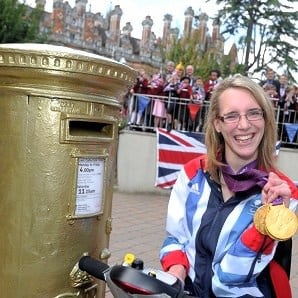
This week we’re featuring an interview with Sophie Christiansen. Sophie won three gold medals in dressage at London 2012 to along with two golds, a silver and a bronze at Beijing and Athens. We interviewed her in London just before New Year:
When we met up to talk to Sophie Christiansen she had just been to a top-secret meeting in Downing Street. “I can’t tell you what it was for, but you might be able to guess” she cryptically informed us. The next morning, the New Year’s Honours List was released and Sophie was given an OBE to go along with her MBE, seven Paralympic Dressage medals and many other achievements. Only twenty-five years old, Sophie seems to have done more than most people ever manage. Yet for all of her successes, she comes across as being very modest and possessing a real sense of awareness, to go with a slightly self-deprecating sense of humour. “I thought David Cameron should have invited me in for a cup of tea today,” she joked, as if that would never happen, adding that “we could have talked about accessibility on public transport”.
We spent some time with her, talking about her opinion on that topic as well as on the Paralympics, getting disabled people involved in sport and the importance of having an attractive personal trainer:
Sophie was born with cerebral palsy and got involved in horse riding at a young age as a form of physiotherapy. “I started at the age of six with Riding for the Disabled,” she told us, “just to give me a bit of help with my coordination and balance. The RDA is a big national charity with about 80,000 volunteers to help disabled people ride.”
“I instantly fell in love with horses and the freedom that they gave me so I continued riding,” Sophie enthused. “Then at thirteen I found out about Para-dressage. That was at a special Riding For The Disabled group called South Bucks RDA, which specialises in getting therapy riders into sport, and I’ve been there ever since.”
Horse riding works well as a form of physiotherapy. The three dimensional movements of the horse are transmitted through the rider’s body, helping to strengthen core stability, reduce spasms and improve balance, posture and coordination. “It definitely helps with my balance and coordination,” Sophie said. “I think without riding I definitely wouldn’t be as able bodied as I am. I even felt it after the Games. After about two months of not doing any sport I could feel a slight deterioration of my coordination”
It works well as a form of physiotherapy and is great to help gain confidence but, Sophie tells us, dressage is probably not the best form of aerobic exercise: “I go to the gym to top up on what I need to ride. I’ve got a strength and conditioning coach who I have a session with once a week and I also go twice on my own. He comes up with a programme to help with my core and I do a bit more aerobic exercise than riding a horse.” Of course, as a Paralympian, Sophie has to do more than the average person would, in order to make sure she is in peak condition. “In a gym I do more than I would on a horse,” she explained “so when I ride I’m fit for purpose”.

At Blue Badge Style we often have people telling us that they want to go to the gym but can’t because their local gym is inaccessible. When we asked what she thinks about this she told us, “I’m quite lucky in that I get help from UK Sport, so there’s the English Institute Of Sport which has a special gym for athletes. I go there and to David Lloyd which is a bit nearer to me. Both are perfect for access.” Her advice to people who can’t get into their local gym was simple: “you should complain – politely – then at least you’ve told them”.
Riding may sometimes have the image of being a slightly exclusive activity to take part in but Sophie disagrees with this view. In fact, she told us that the inclusivity is one of the best things about it. “That’s what I like about dressage really,” she said, “There’s no restriction of age or gender. My main rival in Para-dressage, Anne Dunham, is 65.”
It says a lot about the quality of Great Britain’s dressage that Sophie feels her greatest challenge this year, even more so than competing at the Paralympics, was against Dunham in the qualifying for London 2012. “If we’d both gone we would have got gold and silver because we’re so close,” Sophie thinks, “but Great Britain’s so good at dressage that only one of us could go and at my last selection trial I really pulled it out the bag. For me just getting selected was harder than actually competing at the games.”
There are still some possible limitations involved in riding. For instance it’s hard to find places to ride in Central London “It’s difficult to keep horses here,” Sophie succinctly pointed out – which is fair enough really. “There’s one centre in Hyde Park but that’s it. I compete in Patchcetts which is near Watford, so that’s on the outskirts of London. But if you want to find somewhere to ride you should have a look on hoofride.co.uk”
The most obvious issue would probably be the cost of riding. We asked Sophie how much it is to participate. “Because Riding for the Disabled is a charity it will be a minimal amount,” she said. “At RDA level it’s not very expensive but when you make the decision to compete that is when you really need the money because you need the right horse, to look after it and to pay entry fees.” How much is a horse? “You don’t want to know. My horse, Rio, was quite cheap because he was quite old when I bought him but compared to diving when all you need is a pair of Speedos…” Sophie joked.
She seems to be enjoying the, fully deserved, attention she’s getting at the moment. “Four years ago I was still a double gold medalist but no one knew who I was. This time I can hardly walk down the street without someone recognising me and it’s amazing,” she said. “London was definitely when the Paralympics became on a relative par with the Olympics. I think more could be done but it was definitely a massive step in the right direction.”
Sophie feels that perhaps one of the problems, with putting the Olympics and Paralympics on the same level as one another, was apparent in the opening ceremony of the Paralympics: “I think they tried too hard to make it different.” she suggests. “They kind of focused on disability, which is what makes the Paralympics different, but I think it was a bit too much.” There were still many positives from the ceremony – particularly the appearance made by Stephen Hawking: “that was cool. We saw it on TV because we were competing a couple of days afterwards. I would like to have met him.” – But she felt the emphasis on disability was unnecessary.
Having missed the opening ceremony the closing ceremony must have been all the sweeter. “It was a party and a half,” Sophie exclaimed. “It was good fun. Although it was a bit like a Coldplay concert. A bit too much Coldplay; even though I like them. But then Rihanna popped up, and Jay-Z. It was all good fun. It’s great that the Paralympics can attract such a high calibre of artist”
Having already competed at Athens and Beijing Sophie felt London was the best Paralympic experience yet. “I think it being the home games – nothing can beat that. I loved every second of it,” she beamed. “At Beijing a quarantine issue meant that they had to compete in Hong Kong, making it feel less like a ‘Games’ and more like a World Championships. But we got to go to Beijing afterwards and I’d never been to Asia before so it was just amazing.”
Sophie has recently been seen campaigning to improve accessibility on London transport or, as she modestly terms it, ‘banging on about public transport’. “I don’t think Peter Hendy (Commissioner of Transport for London) likes me very much,” she confessed to us unabashedly, “I interviewed him on the BBC and he couldn’t answer my questions.”
We wondered whether she thinks accessibility on London transport has improved much over the last few years. “Not really,” she feels. “It’s very half-hearted. They’re keeping the ramps that they brought in for getting on and off the train during the Games but that’s nowhere near enough.”
Sophie’s particularly passionate about making London’s new Crossrail accessible. “I bet you any money they’ll build it and not make it accessible and that’s wrong in this day and age.” she fumed. “Their argument is that it’s been in planning for years but, well, disabled people haven’t just popped up.”
If not enough has been done in London, even with the Paralympics taking place there, we wondered what accessibility is like in the other Paralympic cities that she has visited. It sounds like they’ve done a good job. “Because it’s quite modern in Beijing it was quite good,” she said.“Athens did an amazing job of making an ancient city accessible. There was even a lift up the side of the Acropolis!”
Recently, post Paralympic commitments have been keeping her busy and she has had to fit training in around her other work. “I’m not full time” she told us. “I kind of fit it in when I can but definitely, come tomorrow, I’m going to be ‘back back’.”
So, once she’s back in the saddle, what will the future hold for her, and will she back for Rio in 2016? “Rio’s a long time away,” she sensibly said. “I think that will be the aim at the end but I need to set more attainable goals year by year. It goes Europeans, Worlds, Europeans. I’m not aiming for Rio right now; I’m aiming for the next championships.” The European Championships are in Denmark this year. We suggested she should download the BBS App, to find restaurants and hotels and Denmark, which she promptly did.
Before Sophie left we asked her what advice she has for the less able who want to get involved in sports: “I think definitely the key thing is to do some research to start with about what’s in your local area and what you’d like to do. But don’t be afraid to ask people,” she advises. “If your gym is inaccessible, ring up and complain, because then at least they will realise they’re inaccessible and they will be able to point you in the direction of an accessible gym as well. Maybe if you’re a bit afraid of what you can do in the gym then ask them to show you around or have some personal trainer sessions.”
“With a good looking trainer?” we asked: “Definitely,” she giggled, “That’s my advice”
Thanks to Sophie for contributing to the BBS Sports Blog. Next week it’s the turn of Wheelchair Rugby star Myles Pearson.