
The James Dyson Awards celebrate, encourage and inspire the next generation of design engineers. The competition brief is simple: design something that solves a problem. After all, it has been said that that is the essence of good design. One area where we still have many problems to solve through design is disability and, as a result, there are lots of exciting new assistive ideas to look at from ‘The Dysons” (presuming that somebody, somewhere has called them that before). Here are the best designs we saw in the 2014 awards:
The Luke Stairwalker is an assistive device to help elderly and disabled people who have trouble climbing stairs. The device is an adapted hand grip that can lock onto customized handrails and provide a more ergonomic support for walking upstairs. The gripping device gives extra support on the stairs and has mechanism that means it won’t slide back in the wrong direction. Additionally, there is a backrest that can be positioned in the rear to rest on when necessary and to act as a safeguard from falling. It could be a cheaper alternative to having to have a full stair-lift installed and the design was awarded with a top 20 place in the competition.

The creatively titled Vehicle For The Disabled is a re-imagining of a wheelchair, specifically designed for transporting paraplegic people in a standing up position. It’s a concept for an electric wheelchair which would be more adjustable and practical than the majority of wheelchairs are at the moment. The idea would be for the vehicle to mainly function with the user in a standing position but with a lifting system in the chair that could raise and lower the user, as and when necessary, and a swivel function to make getting into the chair easier. As you can see below, it’s very much just a concept at this point but it’s a bold one for a real alternative to standard electric wheelchairs.

Great minds were thinking alike at the Dyson Awards, which lead to another design in a very similar vein to the ‘Vehicle for the disabled’ in the form of Qolo – one of the overall winners of the James Dyson Award and the best performing design relating to disability. Qolo is also a wheelchair device for upright locomotion and sit-to-stand transfer but the really remarkable thing is that it allows for hands free movement. The device is controlled by small movements of leaning forwards and twisting left and right to control where you go. This means that the experience closely replicates standard movement behaviour of the ‘not yet disabled’ and restores three locomotion functions used before getting lower limb disability. It really is an innovative new idea.

20:20 is a Universal Timepiece which uses both visual and tactile methods to tell the time. Obviously it’s the tactile function which makes this watch innovative and assists people with visual impairments. The outer minute dial and the inner hour dial rotate about the fixed reference dial, all of which use indentations to indicate their relative positions. This means that you can feel what time it is rather than needing to watch the watch hands go round. It’s a good idea but it is one we’ve seen before in the form of the Bradley Timepiece which is a bit cooler, a little bit clearer and crucially is already available to buy.

Another James Dyson Awards design which reminded us of something we’d seen before is The moveker C1 – which was awarded a top 20 place at the Dysons (still not sure anyone calls them that). It’s a clever wheelchair design, using a lever system to mean you can go further and faster. By generating power through levers, attached to each wheel, the difference in effort required is remarkable and this wheelchair looks quite cool too. Having said that, it also looks quite a lot like the Leveraged Freedom Chair which applies a very similar mechanism and has been around for a while. Of course two people can have the same good idea separately but we have seen this sort of thing before, which rather takes away from the ‘wow factor’ for us.

Two designs for prosthetic limbs featured and we’re going to group them together as they’re vaguely similar although very different at the same time. Limbitless is an affordable, functional, 3D printed arm replacement, for children who are lower arm amputees. It has an inbuilt mechanism allowing the wearer to pick up objects and use their arm as they could before amputation. The other prosthetic design was KLIPPA, a prosthetic leg designed specifically for amputee rock climbers. It’s unique design has a high level of flexibility and articulation compared to standard prosthetics. Both fill their own niche and have new approaches to increasing function and mobility through prosthetic limbs, although most people would probably agree that Limbitless is more ground-breaking.

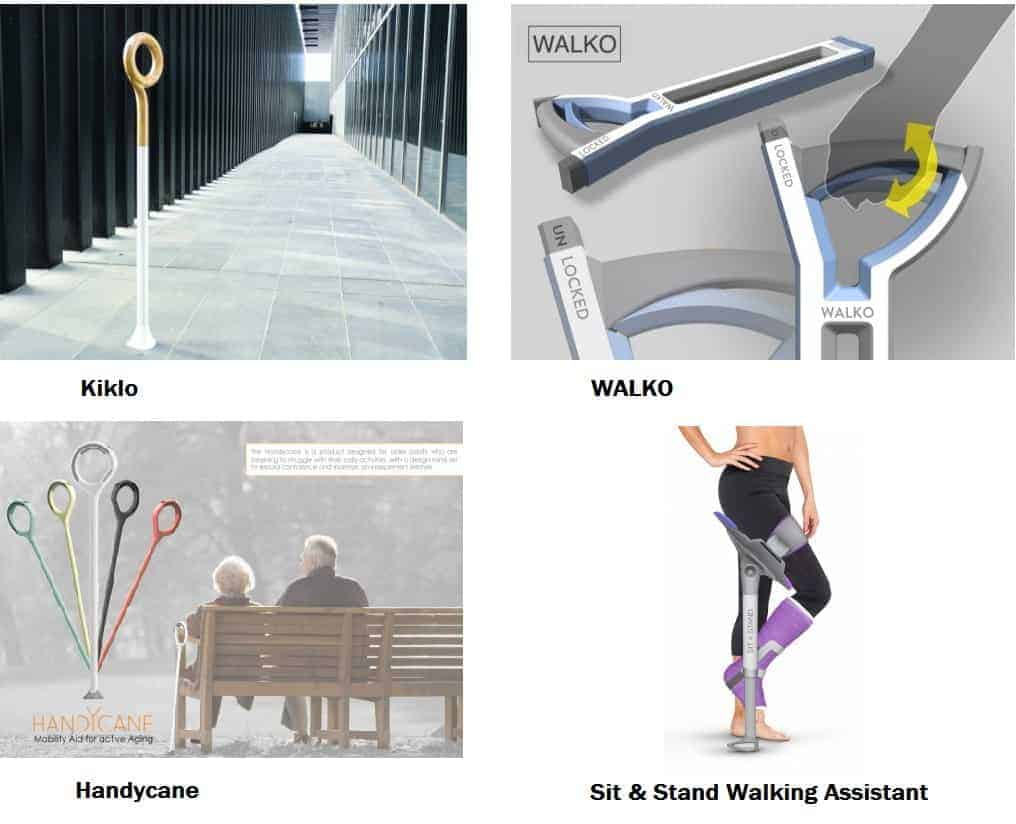
Finally, there were four different designs for walking aids at the Dysons, which again we’ll group together. Firstly, there was the Sit & Stand – a hands-free walking assistance device which is worn by attaching it to your leg. Somewhere between a crutch and a prosthesis, this is an innovative solution, but more for short term injuries than long term mobility problems.
Then there was the WALKO design for a collapsible assisting walking stick, which uses the aid of hydraulics system to ease and support the user through walking, standing up and climbing up stairs. It’s practical for storage but perhaps the hydraulics system is aiming a little to high for the market at this stage.
Less innovative but more attractive, the Handycane and Kiklo are quite similarly styled walking sticks with looped handles and muted colours. Both are ergonomic and look appealing. Once more we’re seeing that great minds truly do think alike as, not only are these two designs so similar, we’ve also seen other variations on the Handycane/Kiklo theme from other designers prior to the James Dyson Awards. So many designers can’t all be wrong so were sure something like this will be available to buy soon.
There were many interesting assistive designs featured at the James Dyson Awards. It’s wonderful to see a design titan using his profile to highlight innovative new ideas from young designers in the world of assistive tech. The process begins all over again next week when this year’s competition opens and we look forward to seeing the exciting designs that the next generation of designers come up with in 2015!
[…] Blue Badge Style Website has a news item about the James Dyson Awards and there are some good examples of innovation and design in assistive […]