
Outside the Duke of Cornwall Spinal Treatment Centre at Salisbury Hospital lies Horatio’s Garden – a beautiful, peaceful, restorative haven for the patients there and a fitting tribute to a young man who played a key role in its creation before passing away much too young. It’s a wonderful space and a beautiful idea.
Horatio Chapple was a seventeen year-old Eton schoolboy, who planned to study medicine at university and enjoyed volunteering at Salisbury spinal centre in his school holidays, before he was killed in tragic circumstances whilst on an exhibition in Svalbard. It was Horatio’s patient research, taking time to find out how to improve the centre, that had established the need for a relaxing outside garden space to be made for the long term patients staying at the centre to enjoy. Sadly he was never able to see the garden himself and instead the garden was named in his honour as “a symbol of the hopes that Horatio had for a future of making a difference to the lives of others.”
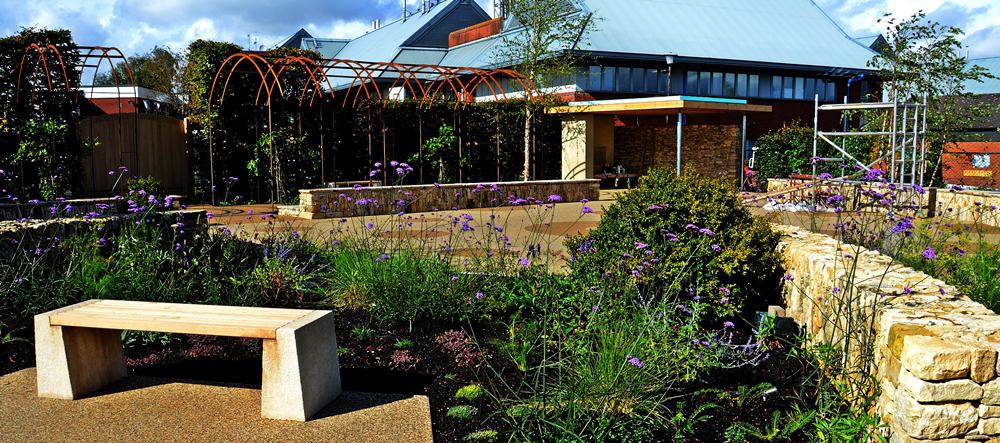
Horatio’s Garden is a beautiful garden at Salisbury Hospital, designed specifically as a space for patients at the spinal treatment centre there. Horatio and his father David Chapple – a spinal surgeon at Salisbury Hospital – came up with the idea for the £300,000 garden, at the hospital’s Duke of Cornwall Spinal Treatment Centre. It was funded through charitable donations, from people who saw the potential benefits of the garden and from many of Horatio’s friends, who organised fundraising events after his death so that his vision could be made a reality. It’s a touching gesture that celebrates his life and helps provide an outlet for the patients there.
This garden’s main purpose is to be a sanctuary. Many, if not most, of the patients at the treatment centre have experience massive life altering changes and have to make major adjustments to their lives, often with reduced mobility and extremes in body temperature. It’s helpful to be able to go outside, in a hospital bed or wheelchair and experience fresh air, sunlight, wind and even rain. Previously, the only space for this was the car park; Horatio’s Garden provides a beautiful, tranquil and enjoyable space for people to spend time with friends, family and fellow patients.
Patients being treated for spinal cord injury face long stays in hospital during which time they undergo an intensive and demanding rehabilitation programme, re-learning the most basic of skills. Anyone who’s ever been in hospital for even a relatively short spell of time will know how isolating and monotonous the experience can become. Many of the patients at the Spinal Treatment Centre stay there for up to, or over, a year. Horatio’s Garden provides a real escape from this routine. If nothing else it allows people a dose of fresh air and a change of scene, both of which may seem like small things but are hugely beneficial and satisfying.
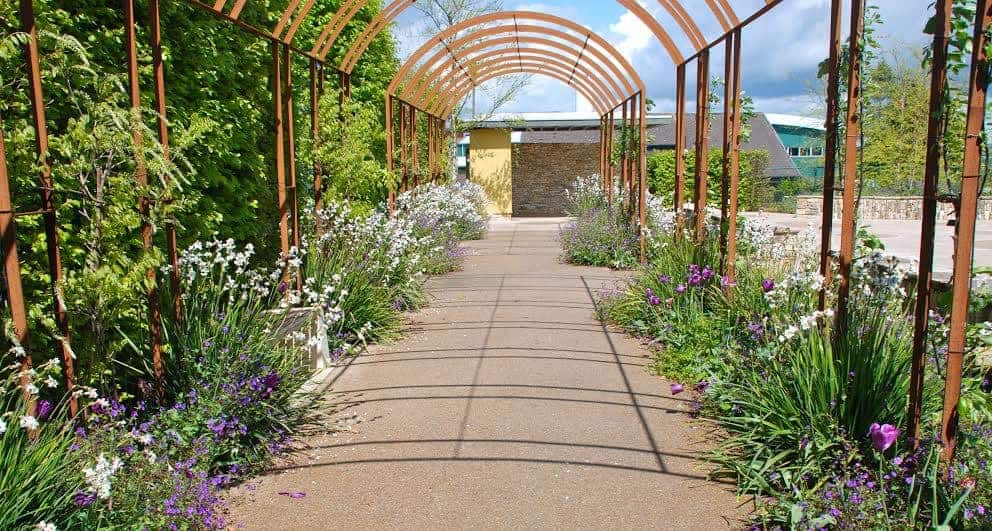
One of the best gardeners in the business, in the shape of Cleve West, winner of the Best in Show at Chelsea in 2011 and 2012, took on the task of designing the garden. In a detail that further shows how Horatio’s Garden was a labour of love, West also had a personal connection to the spinal centre because his best friend had been a patient there. He used Horatio’s patient research as the starting point for the design and then listened to patients, nurses, therapists, doctors, managers to work out what the design needed to incorporate. He even asked to be taken around the site in a hospital bed and a wheelchair to get a patient’s perspective.
He discovered – a sensation that wheelchair users will be familiar with – that hospital beds are very sensitive to any little bump or crack as they travel across the ground, so creating smooth resin-bonded gravel running pathways a minimum of 2.5m (8ft) wide were essential. As a result a lot of the garden is pavement but West’s design finds ways to let the garden feel full of life. Plants were chosen for their aesthetic and multi-sensory qualities- “grasses to catch the wind, herbs to smell and taste, and shrubs and trees for texture and winter structure” – to stimulate the senses. The design also incorporates the form of the spine in a series of low limestone walls, which act as a metaphor for recovery and, on a more practical note, as seating for families. The result is a picturesque and calming little idyll which has been a real hit with the patients and staff.
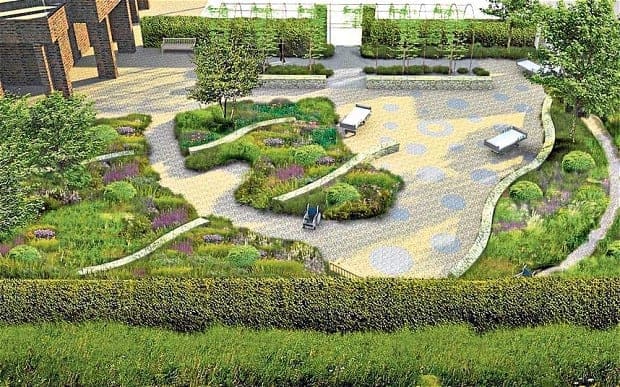
The garden has done so much for the patients in Salisbury. Just giving somewhere to relax and recover is a major change to the centre and the garden also gives an opportunity to take part in gardening activities which work well as a form of occupational therapy. The Horatio’s Garden trust is now hoping to eventually roll out Horatio’s Garden to other spinal units across the UK so that other people recovering can have a similarly positive experience.
Horatio’s Garden is such a fantastic project with a truly moving story behind it. It’s a beautiful space, a beautiful idea and a beautiful tribute to a young man for whom the garden meant so much.
What a beautiful piece. I loved this blog, just shows what can be done.
What a beautiful and piece. Well written and heartwarming.