
The Transport For London’s exhibition at the Excel Centre yesterday showed the current level of access on London transport with life-size mock-ups of Tube and rail stations and street environments, interactive exhibits, talks and people on hand to discuss issues and solutions regarding transport. It was a chance to discuss what TfL are doing right and what they’re doing wrong but from the Mayor’s Office, that a further £75million has been made available for renovating London’s Underground stations in order to improve their accessibility, stole the show. Maybe this overly cynical, but it seemed like a slightly calculated move intended to make sure that the takeaway point, of what could otherwise have been a fairly underwhelming exhibition, was that TfL are dedicated to accessible renovation.
Renovation
The fund has been put aside to enable the installation of new lifts at “around a dozen more stations” over the next ten years and timed to coincide with the exhibition on accessibility. The Mayor of London, Boris Johnson, said: ‘The Tube was built at a time when accessibility was not top of the priority list and that’s something we’ve long been battling to rectify. Great progress has been made in making an ever-growing number of stations step free, and while the picture is far from perfect, this injection of cash is another step in the right direction.”

At the moment, it could be agreed by anyone who went to the exhibition that access is still a problem on London transport but it is steadily improving. Only about 50% of Overground stations are step free but by the end of 2015 this should increase to 60%. Similarly, 140 London Underground stations are currently step free and TfL has plans make at least 60 more step free by 2023 – their target year for most of their current access goals. It is expected that in 2023 227 million step free journeys will be made.
A lot of work is being done to improve transport, both from TfL and outside influences campaigning for better access, and this exhibition helped show off the latest buses, trains and taxis. Accessibility has come a long way and there were lots of positives to find in the attitudes shown by all involved. If attitude was the only problem then, on the basis of yesterday’s exhibition, we would almost have solved it. All the TfL staff there were fantastic and were really on top of things. Unfortunately, infrastructure remains crucial and there is still some way to go there.
Innovation
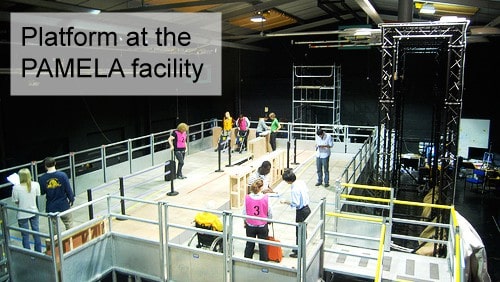
Stats and figures on renovation weren’t the only way the exhibition allowed us to glimpse into the future. The University College London Accessibility Research Group had a stand at the exhibition where they were telling people all about their latest work in the world of transport. One of the incredible aspects of their work is the PAMELA laboratory facility. PAMELA is a vast laboratory recreation of a pedestrian space, which is fully configurable so that real-world conditions can be replicated in controlled setting. The surfaces are interchangeable and the platform can be made to slope up or down meaning that you can test all sorts of different accessibility related issues and get data on them in a safe setting. It provides a unique space for UCL and outside researchers to understand the problems that less able people have and how to solve them. It’s quite an extraordinary space.
The UCL team were also promoting the Transport, Accessibility and Rehabilitation Services Advisory Network (TARSAN) which is a forum for people to contribute on accessibility and the environment. The UCL research group may have top of the range equipment, like PAMELA, but without input from people with varying abilities it would be far less useful. They look to find out how real people interact with the world and to use this information to “revolutionise transport, accessibility and rehabilitation”. They’re always on the look out for people to get involved and anyone can help with their own input. If you’re interested then get in touch with them here.
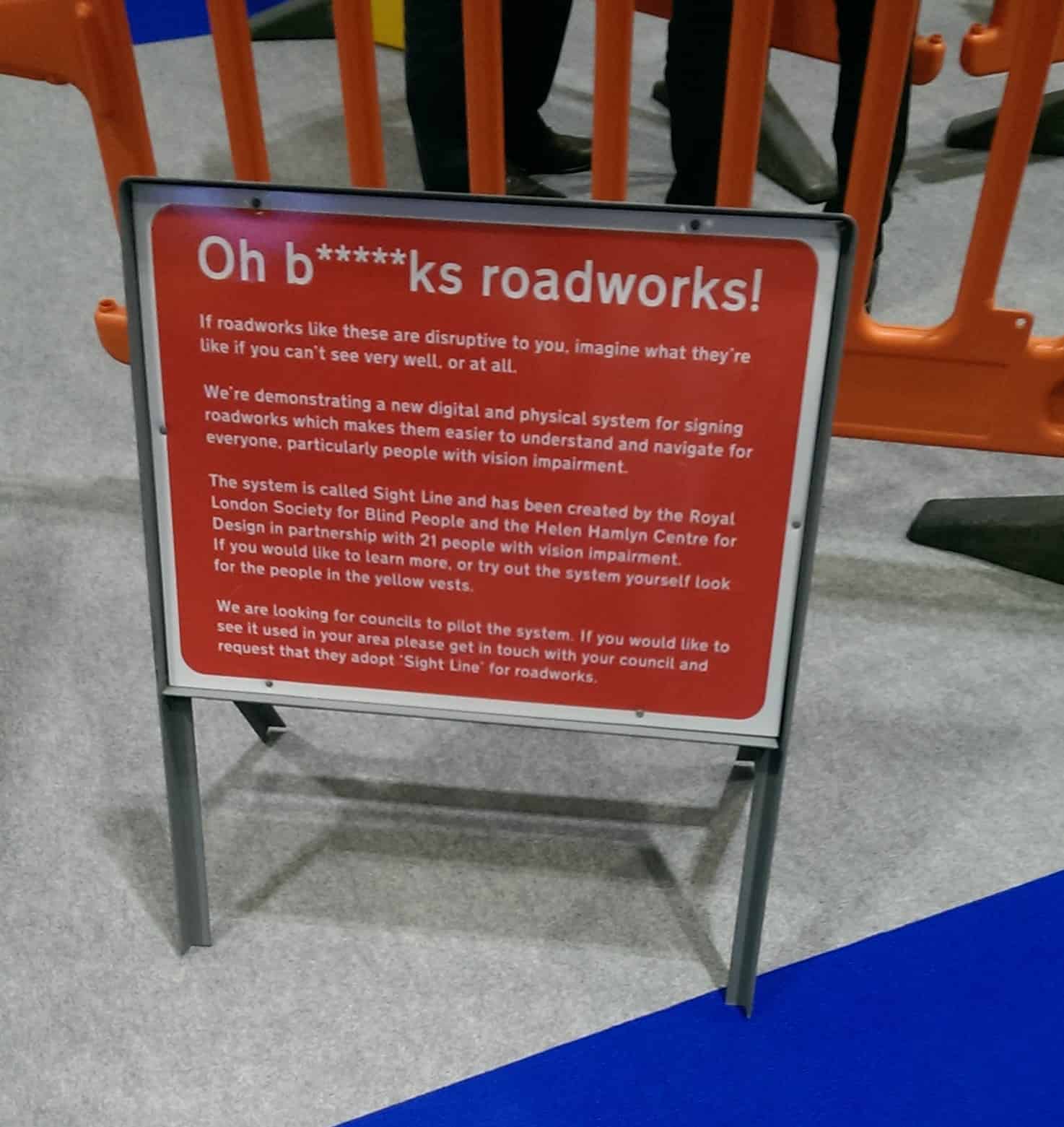
On a different note, a new digital and physical system for signing roadworks, called Sight Line, from the Royal London Society for Blind People and the Helen Hamlyn Centre for Design, was on display . The system makes roadworks easier to understand and navigate for everyone but particularly for people with vision impairment. It’s a holistic approach to make our pavements more accessible which includes rethinking how we plan them entirely as well as integrating the latest technology. It was an interesting innovation with an eye catching display.
Improvisation
Our final experience at the TfL Accessibility Show was a rather odd piece of improvised ‘theatre’ designed to show off how TfL use role play exercises to train staff. A patient audience was treated to a not all that short tale of an amputee on the way to a job interview and needing assistance from a member of staff. The scene was played out twice – once with the staff member treating him appalling and then repeated with better customer service – in between, the audience had a chance to participate and debate how staff should approach accessibility.
It was a rather unusual insight into staff training and it did drag on a little. At least the actors taking part (and in fairness much of the audience too near the front to leave) seemed to enjoy it. I didn’t, but I did appreciate how it showed that TfL staff are not only showing a good attitude towards disability but are now actively trying to take part in discussing it!
The underground is still a total disaster in the West End and the City. I went into London via Euston to see an exhibition at Tate Britain. Nearest access was Green Park then £10 in taxi fare each way. OK I could have got a bus. Which ever way you look at it is not good or should I say f*****g s***e