
To say that House of Commons Committee Room 9 was unprepared for the arrival, en mass, of around ten to fifteen wheelchair users would be an egregious understatement. In fact, it would probably be fair to say that the accessibility of the room which hosted yesterday’s parliamentary event on accessing the high streets was almost as big of a let down as this year’s Spanish football team. Fortunately, attendees didn’t let the difficulty getting into the meeting affect their enthusiasm or productivity and we enjoyed a thoroughly insightful and informative discussion of the problems regarding accessibility on the high street and how to fix them. It was just a shame that no retailers or business insiders were there to hear it.
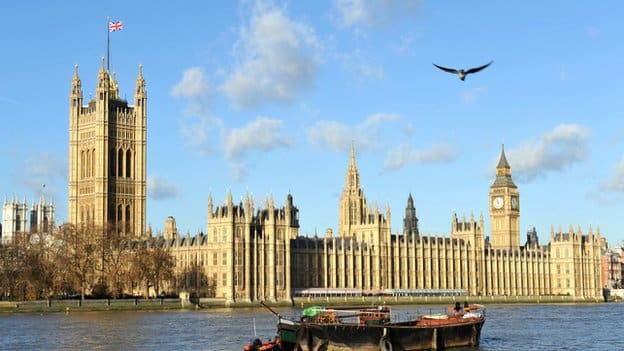
For one reason or another, the day before the meeting was due to take place, it was moved from a very accessible room in Portcullis House to Committee Room 9 as well as being inconveniently put forward by an hour. This was far from ideal given that it meant plans had to be changed at the last minute, but it was made worse by the fact that the new room was on the first floor of Parliament and in the deep depths of the building (or at least it felt like that after all the snaking through the back corridors we had to do).
It was a rather bizarre sight to see a line of wheelchairs twisting and turning through the bowels of Parliament, like a giant millipede, towards the lift taking us to the first floor. It was good to see that they did have a specialist lift reserved for wheelchair users only (and Members of Parliament of course: we couldn’t have them taking the stairs now could we?), although it might have been nice if we hadn’t had to queue for quite so long, to go up one by one. If only there had been a room on the ground floor, eh?
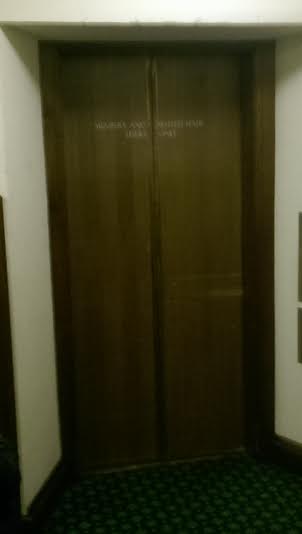
We were told at the meeting that, because it’s a royal palace, the Palace of Westminster is exempt from the usual laws regarding accessibility. That they take this exemption seriously became more and more clear as the day went on. OK, it wasn’t the least accessible building you’ll ever see, we shouldn’t paint it as being some kind of legislative adventure playground, but the path to and access within the room we met was pretty hopeless. A tip for all administrative organisers: if you’re going to hold a meeting to discuss access to the high street, don’t do it in a room with narrow aisles of fixed tables which wheelchair users can not fit down. The traffic jams at each of the committee rooms two doors were slightly farcical and a great deal of the Trailblazers ended up staying nearby the rear door, towards the back of the room. Multiple apologies were issued, most of the furniture (that could be) was moved around a bit and we soldiered on.
Fiona had been asked by the Trailblazers to attend in order to lend her expertise and experience to proceedings. Given that the Trailbazers represent young disabled people, Fiona had initially suggested that she may have a little too much experience to attend. But as she was actually asked to be one of the members of the panel, she excelled at bringing her knowledge of current legislation and first hand understanding of the key problems. As a wheelchair user who reviews venues for accessibility she was an ideal person to sit on the panel. The problem was that, as it was on a raised platform, the panel was not quite so ideal for her to sit on. But with a bit of lifting and good old fashioned shove, we managed to get her wheelchair up onto the platform and into the action. Again, the irony of holding an event to discuss disabled access in an cramped and inaccessible room was noted.
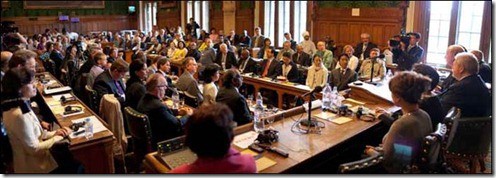
That’s more than enough criticism to be getting on with for now (but be warned that it may resurface before the end of our tale); let’s focus on what really matters – the content of the meeting. Paul Maynard MP was set to chair the event, but due to the last minute rescheduling he had to share the honours with Baroness Celia Thomas who graciously stepped in for the first half. Fiona was joined on the panel by Helen Carter and Brenda Puech from Accessible Environments and Trailblazers very own David Gale. All offered insight into the current standards and regulations for high street shops and, along with input of the other people present, came up with ideas for how to improve customer experience for disabled people.
There were several key takeaway points from the meeting for ideas of what could be done going forward (we’ll address these in further detail in a later blog). The first idea was to develop a standard form letter which could be sent to inaccessible buildings. The fact that disabled people have to contact businesses themselves to cause a change to happen was identified as a current problem, especially as it takes time and energy to do so. Perhaps a form letter to send to businesses, highlighting, in a positive way, how they can improve could help ease this process until we can change it. Another idea was to establish a charter of accessible businesses that retailers can sign up to. This would encourage retailers to see accessibility as a positive asset that they can aspire towards and it would also let disabled customers know what shops are going to be easiest for them to use. “Would retailers sign up?” one attendee ask. We thought yes, but how could we be sure when none had turned up to the APPG?
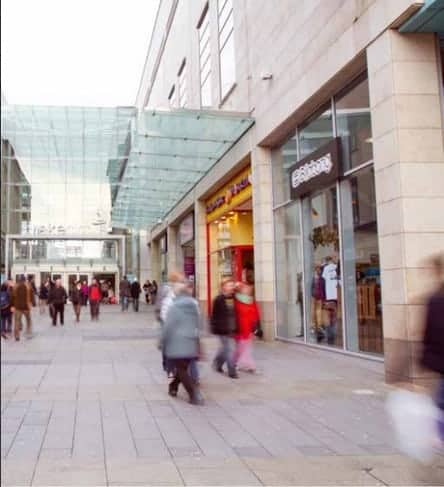
This was possibly the most disheartening aspect of the day; the lack of retail insiders present seemed lazy at best and at worst uncaring. It didn’t make the event pointless, as we still all shared a lot of idea, but it did take something away from it. As was mentioned at the meeting, the disabled market is worth over £80bn per year and we’d like to think that businesses and groups of reatilers would be interested in hearing feedback on how to improve their facilities. If they won’t do it for the people, they could at least do it for the eighty billion quid!
Despite the ‘under-representation’ of retail and business leaders it was a productive meeting and a good opportunity to share thoughts and ideas with the Trailblazers, the Centre for Accessible Environments and everyone else who attended. It was also just a good two hours spent with people who clearly share our passion. We heard yesterday evening that Trailblazers have managed to secure a further meeting with the British Retail Consortium this September, so hopefully that will be a chance to get the feelings of the APPG across to retailers!
Trailblazers is an outstanding organisation who we were proud to work with and we’re sure that their work will be making perceptible differences to the way we experience the high streets very soon! The access at the House of Commons may not have been great, but it was still the House of Commons, so it was a fantastic opportunity for everyone involved to get their points across. We just hope that the BRC and individual businesses will eventually respond to these points.