
Last Friday we posted an article on the new mobility designs recognised at this year’s iF Awards. The awards are highly prestigious in the design world and can help to make or break a project. After the popularity of last week’s piece we thought it would be fun to have a look back at the history of the wheelchairs that have been given iF Awards and to find out where they are now, what succeeded and what could have been. Here’s what we found out:
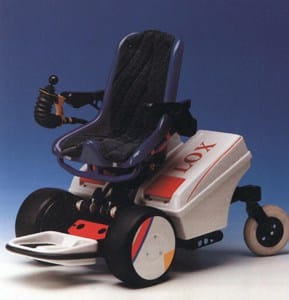
This rather clunky looking Rollstuhl wheelchair was recognised with a 1989 product design award. The last quarter of a century hasn’t been kind on this sort of relic but it does show how far technology has come in reducing the bulk needed on power chairs. It’s difficult to really view this with much perspective as the design is older than this writer.
Where is it now? In fairness this was from 25 years ago so it’s hardly surprising that this model is no longer on sale!
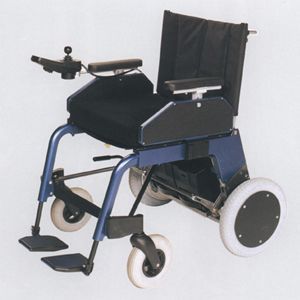
This Evantgarde a100 was recognised with a product design award ten years later, in 1999. It’s a powered chair without the overwhelming heft of earlier designs. It actually looks more lightweight that many power chairs in 2014 but also less comfortable and less powerful. It always seems a little cruel to be to critical of design from so long ago but this is a little bit of a boring and functional look compared to how stylish and sleek the best wheelchairs are these days.
Where is it now? Ottobock, the designers of the Evantgarde, are still going strong and are one of the world’s leading wheelchair suppliers, with a range of more streamlined power chairs including an a200 update. You can see elements of this design that have been taken and adapted into the latest chairs but perhaps it’s best if we zap forward a bit to the noughties.
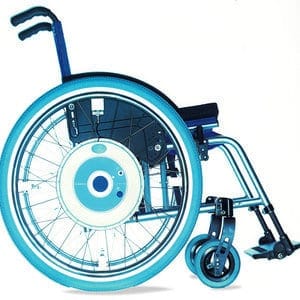
Not a complete wheelchair design, in 2001 the e-motion was (and is) an innovative reinterpretation of how to adapt manual wheelchairs into power assisted ones. The e-motion power assistance device is an intuitive design that assists normal manual wheelchair propulsion by up to 80%. It was a ground breaking design recognised with a place in the top 10 designs at the 2001 awards. It’s not only a intuitive and helpful design but it fits in seamlessly to the wheelchair too.
Where is it now? E-motion wheels are still available in pretty much the same form that they appeared in in 2001. We included them in a piece on wheelchair power packs last year along with the e-fix, another product from the same designers which uses a joy stick system.
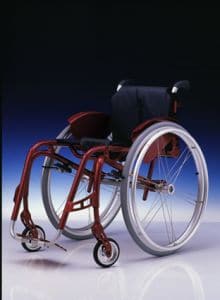
In 2006, the FXOne wheelchair design was given a gold award – something only a select few products receive each year. It was one of the first wheelchair designs to use a three-dimensional bending procedure which gives it a curved form without losing rigidity. It’s lightweight and looks good as well as being very flexible and adjustable, even when you’re sitting in it.
Where is it now? Meyra, the company that designed FXOne, continue to produce these chairs although they have been overtaken in both style and practicality terms since 2006. Wheelchair models from the likes of Quickie, Panthera, Carbon Black and more have rather usurped the FXOne.
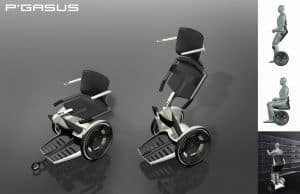
In 2007 the iFs took a big leap forward and got really futuristic with this design concept from Porsche called the P’gasus. The design was of a super modern looking wheelchair which would be able to lift the user into a standing position. It was hailed as the future of mobility for disabled people and was truly cutting edge.
Where is it now? Unfortunately, the P’gasus was never really anywhere in the first place as it was never really anything more than a set of pictures and a vague idea. But you never know, maybe at some point the Porsche Design Studios will pick up the concept again and flesh it out into a real wheelchair.
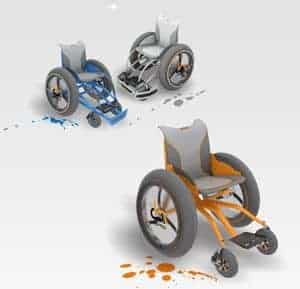
Another design which only ever existed as a concept appeared in 2009 with the Heroes sports chair. The Heroes design is a sport wheelchair designed so that people with mobility restrictions can participate in sports on land and on the beach. It allows people to play new sports such as freshball (a kind of beach tennis; don’t google it), as well as Frisbee, badminton, croquet, wheelchair volleyball and beach rugby. It’s an interesting look with chunky tyres, for use on various surfaces and a good use of colour.
Where is it now? Again, this was a concept that was never produced.
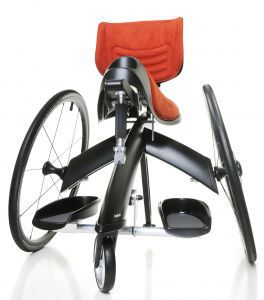
The Krabat Sheriff kids wheelchair was given a gold award in 2010. The wheelchair is equipped with racing wheels with very low friction as well as a saddle seat to provide an active sitting position and prevent the child from sitting in a passive and slumped position. The chair is super light-weight and compact making transport easy. The design of the chair is really out there and looks fantastically cool. It’s a shame there isn’t on for grown ups too!
Where is it now? Krabat is a Norwegian company with distributors in various countries around the world. Unfortunately, the UK is not one of these countries, but if you live somewhere else (e.g. the US) and are under the age of six you might be in luck.
In 2011 Ottobock were back in the iF exhibition with the gold award winning Avantgarde designs. These three wheelchair models came with a bold statement from their designers about a new era for mobility products: “The times where ‘grey and chrome’ were the only design elements are long gone. Wheelchairs have shed their stigmatizing character and instead have received an active and confident expression while being tailored to the individual user’s needs.” Bye bye to NHS grey and hello to the future!
Where is it now? As we said earlier Ottobock is one of the leading wheelchair manufacturers and suppliers. The Avantgarde series of wheelchairs are widely available and popular. Check their website to find out more.

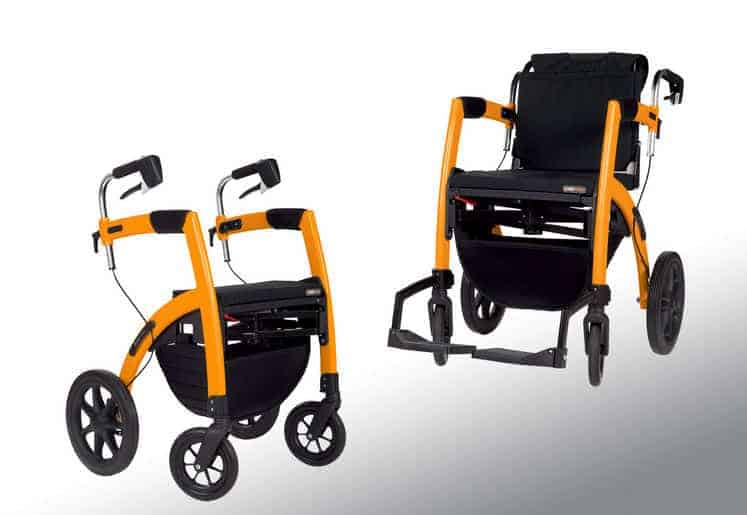
The Rollz Motion combined wheelchair and rollator was part of the 2012 iF Awards exhibition. The clever design allows you to convert it from rollator to wheelchair or vice versa in a matter of seconds. Rollz Motion Rollators are ergonomic, funkily designed and come in four cool colours. The wheelchair mode is comfortable, if a little basic but the rollator is probably the best looking we’ve ever seen.
Where is it now? Rollz Motion Rollators are available at Designed 2 Enable and are really well priced if you think of them as wheelchairs, although rather expensive you consider them to only be rollators. We featured them on BBS last year.
Last year this Smart Chair design was rewarded for attempting to help “decrease society’s stereotypes of the handicapped and become a futuristic suggestion of individual transportation method.” It does look like it could be the next step in making power wheelchairs more modern with its slimmed down design, metallic style and (seemingly obligatory these days) iPad dock. It’s made of magnesium to reduce the weight from 110 kg to only 60 kg, built with the extension frame structure, and has UX-concept-applied convenient appliances to maximize safety and storability.
Where is it now? Since the 2013 iF Award and a Red Dot concept design award the year before, things have gone a little bit quiet on the Smart Chair front. This is a shame because it looks great and it would be good to see an iF Award really launch a mobility design from concept to product. When it comes to wheelchairs it would appear that the iF Awards can help to promote something already in production but not quite give manufacturers the confidence to get something made.

So there we are, twenty five years on from the Rollstuhl and into 2014, where there were several outstanding mobility designs celebrated at the iFs. To see the mobility products in the 2014 iF exhibition take a look at our post from last week.