
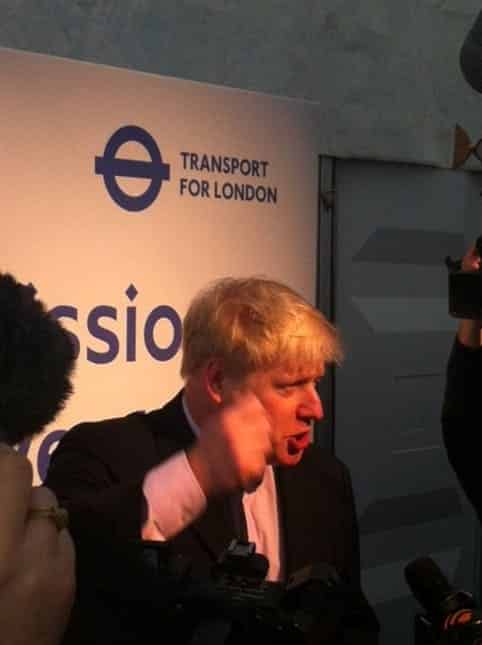
When he’s not busy fighting for the freedom of London’s hardworking commuters/refusing to talk to Bob Crow (depending on what your point of view is) Boris Johnson presumably enjoys the chance to focus on other areas of London’s transport. Recently at Town Hall, he unveiled several new designs for London’s famous black cabs.
The black cab is something of an institution – a moving London landmark – but the current model is now over twenty years old and in need of modernisation. The good news is that two things normally come with modernised design: greater enivornmental awareness and, more importantly for us, improved accessibility. In terms of the former, Johnson has decreed that all new taxis presented for licensing in the capital must be zero emission capable from 1 January 2018. In regards of accessibility, black cabs already tend to be quite good and the fact that all the designs in the race to become carbon free are giving even more consideration to access can only be a good thing. We can all look forward to a thoroughly modern cabbie.
On the other hand, the new design that becomes most popular will probably be the one that is most faithful to the old fashioned, iconic look of the London black cab. If the reintroduction of the Routemaster bus, due to popular demand from the public and the Mayor, is anything to go by, maintaining aspects of the classic design will be crucial, even if it comes with the cost of increasing practicality. The black cab is a iconic image, loved by Londoners, tourists and cabbies alike, so it’s important to find a design that fits into its history. Let’s take a look at the concepts vying to be the next London cab:
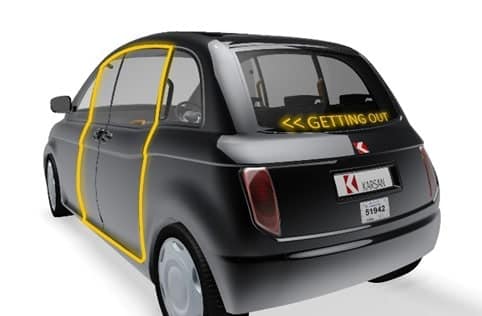
Most Accessible – Karsan Concept V1
Turkish company Karsan have developed the Concept V1 in association with engineering company Hexagon Studio and the Royal College of Art’s Helen Hamlyn Centre. The design is based on the Karsan model for a new New York taxi which was shortlisted for the 2011 New York Taxi of Tomorrow competition. They’ve taken aspects of this design and adapted it for London’s roads.
The access has some extra improvements on current cabs. For instance, the left hand side door is illuminated, for those with reduced vision, and is indicated by a rear window ‘getting out’ message for the benefit of cyclists, pedestrians and other vehicles. Wide dual doors open at 90 degrees, an automated wheelchair ramp can be deployed and wheelchairs can be accommodated so that they face other passengers.
The Karsan vehicle is fitted with an electric power pack and a range extender for zero emission town journeys. The passenger area has a huge set of panoramic windows in roof which helps keep it bright and airy as well as providing better sight seeing opportunities in the city centre.
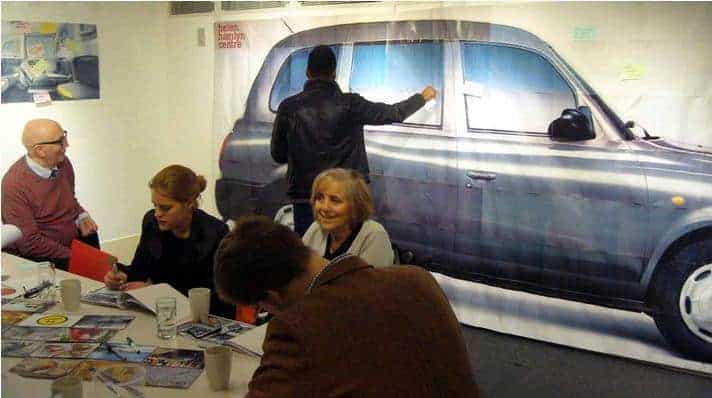
Blue Badge Style founder, Fiona Jarvis, was recently invited to the RCA Helen Hamlyn Centre, as they wanted disabled input on the Karsan Concept VI. She said that “one good thing about this is the door identification for partially sighted and the fact the wheelchair faces front and not back as in taxis today which sometimes makes me car sick”.
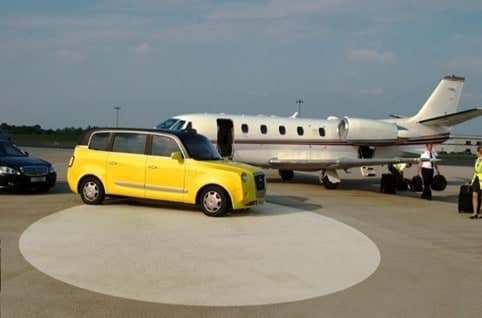
Most Environmentally Friendly – Metro Cab
Also unveiled at Town Hall was the Metro Cab, designed by Fraser Nash and looking to be the most eco-friendly of the new roll out of London cabs. It looks to combat critics of electric vehicles – who argue that charging cars through the National Grid uses up just as much energy by burning fossil fuels at factories – by docking the taxis in solar charging stations. If they did this it could not just power the taxi but feed back into the National Grid.
Designed, engineered and built in Britain, this is a true London cab. Like the Concept V1 from Karsan, the Metro Cab has a huge panoramic roof for improved views. Access features include lock downs for wheelchairs, an integrated wheelchair ramp and full 360 degree movement for wheelchair users inside the cab. It looks really spacious inside and has caught the traditional image of London taxis well.
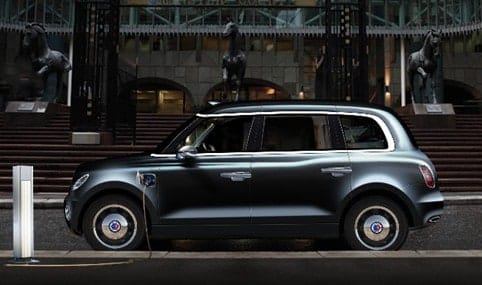
Most Stylish – The London Taxi Company
The London Taxi Company is largely responsible for the image of the classic London cab that most of us have. Unlike newcomers, Karsan and Fraser Nash, the LTC has been producing London cabs for years. In fact, the company has been producing taxis since 1919 and their most recent model, the TX4, is the recognisable shape that we know today and is one of the three models already available, along with Mercedes and Nissan.
They’re planning to enter the new age of environmentally friendly taxis in 2018 so they have less details available at this stage. But they have confirmed that they are only planning to introduce a hybrid electric range “partly because there are only two or three hydrogen fuel stations in London at the moment.” At the Mayor’s office, for the unveiling, LTC’s display was not the design is has put forward – instead it was a hydrogen fuel cell and lithium battery powered electric hybrid providing a 250-mile driving range. But it should give an idea of what the next stage in the development of the classic London taxi.
The Other Contenders
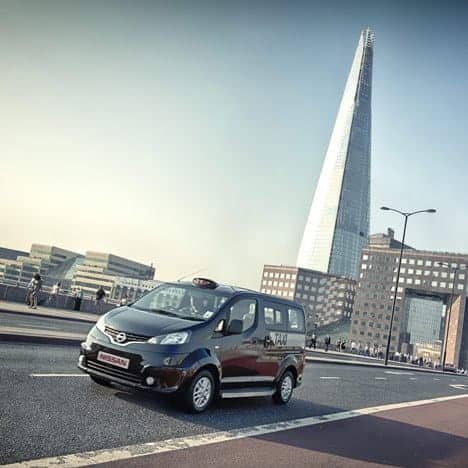
Nissan and Mercedes had already thrown their hats into the ring for the big eco-friendly taxi brawl. Nissan’s taxi adaptation of the all-purpose NV200 was announced way back in 2012 and after testing and taking feedback from the Mayor’s office, the taxi is due for release at the end of this year before an electric version comes out in 2015.
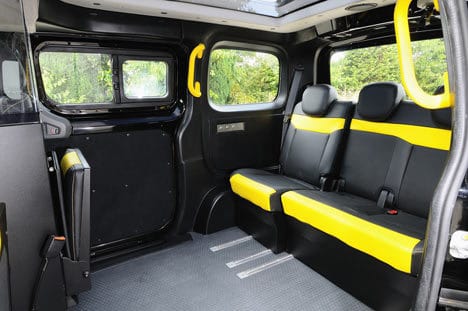
Nissan worked with Assist UK to create a design that was practical and accessible for less able people. As well as a ramp, there are also anchors for a wheelchair and the rear seats are on sliders to create more space when required. Nissan have also said, that round headlamps and a re-modelled grille mirror will be incorporated to give the NV200 ‘the black cab face’ we all know and love.
Meanwhile, Mercedes, who currently have a black cab on the market, do intend to produce a new model in the race for the 2018 electric deadline but have opted to keep their powder dry for now. The German giants can still be expected to be a power player in the new wave of eco-friendly, accessible black cabs.
It will be intriguing to see not only which of these new cabs will be most accessible but which design wins the day and becomes the image of the modern black cab. All of these designers and manufacturers are making their own claim for being the iconic London cab, but which one will win out?