
At Blue Badge Style, we love anything that looks to demonstrate that style and disability aren’t, and should not be, mutually exclusive and the excellent Designing For The Future project is an example of just that. In a world full of dull, clinical and utilitarian products designed for elderly and less able people, they look to design products that will help people in everyday life but also appeal to them stylistically.
Run annually at The University of Brighton, in conjunction with The Future Perfect Company, the project encourages students to design attractive, aspirational, assistive products for older people. Although the project focuses on people of a certain age, rather than specifically on less physically able people, it caught our attention because there is a lot of crossover between the two. The product requirements of elderly and less able people can often be similar and the fact is that for both markets many essential products often lack in style and imagination. The project is about finding ways to rethink these essential but often mundane products and to turn them something people want to use.
One Designing For The Future designer looked at a standard asthma inhaler and gave it a twist to make is desirable. The “Breathe Asthma Inhaler”, designed by Hanna Mawbey, is made of sterling silver which is “both valuable and anti-bacterial, changing the connotations of embarrassment into pride”. It looks very slick and would be a tremendous improvement on the boring usual design and colour, which with inhalers tends to be ‘NHS Blue’. Mawbey has gone on to design a range of bespoke mobility aids outside of the project which you can see on her website.

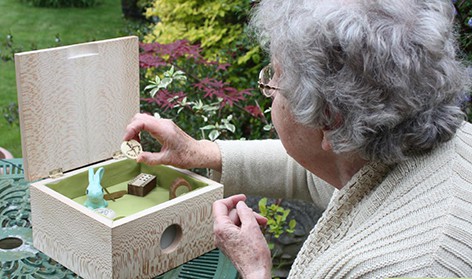
Another success of the project came when Chloe Meineck submitted The Hub. It’s a multi-sensory device designed for people with dementia to store electronically the soundtrack of their life including favourite music, people’s voices and ambient sounds. The Hub then became the basis for her final year project which produced the Music Memory Box which uses different types of stimuli – touch, sound, scent and sight – to retrieve someone’s identity and reconnect them with the family and friends they have lost through dementia.
The design helped to earn her a residency at The Design Museum but the product has also yet to be commercialised. She’s made a video to explain why and how she designed the Musical Memory Box which is fascinating and well worth a watch.
Unfortunately, so far they’re yet to see a winning design put into production. Despite all the hard work and talent involved in the project, this is another case of amazing concepts being created there sadly being literally no end product. But we have high hopes that soon a manufacturer will work out that there is a market for the products and take a bite!
Designing For The Future is an excellent project which highlights the lack of well designed products and facilities out there for the elderly and less able. It’s especially uplifting to see that many of the young designers involved in the project go on to continue working in this area of stylish, assistive design. We hope that they can go on to achieve the success they deserve and bring some much needed style to the so often dour world of mobility products.