
Here at Blue Badge Style we absolutely adore intelligent, innovative and effective design. With that in mind, today we’re celebrating the 80th Birthday of the iconic British architect, Lord Richard Rogers who’s life and work are currently being shown at The Royal Academy.
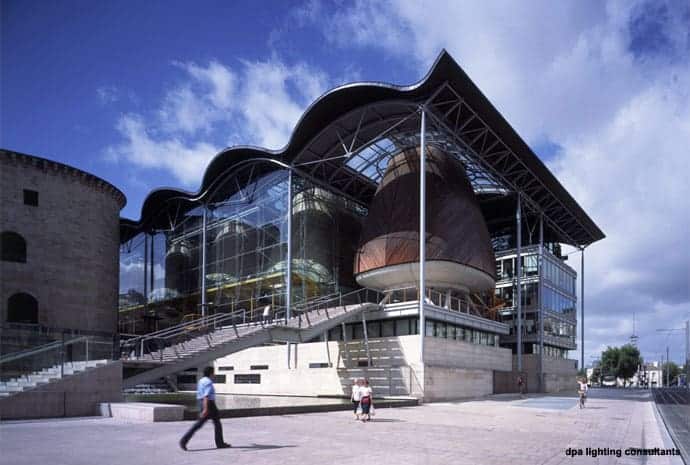
Rogers is a real titan of architecture, famous for his modernist and functionalist designs including the Lloyd’s Building, the Law Courts in Bordeaux, the Pompidou Centre (with Renzo Piano) and many other projects. His work has transformed modern architecture from a purely design oriented standpoint but Rogers’ career has also been notable for his commitment to moral, ethical and social issues in and outside of his own work. His strong social conscience and commitment to sustainability and inclusivity make him rather unique and fascinating.
In 1963, after graduating with a master’s degree from Yale, Rogers set up an architectural practice named Team 4. Among the team of four was noted architect Norman Foster (now Sir Norman – designer of The Gherkin, the restored Reichstag building and many others). The two would only work together for four years but it has been remarked upon that their careers have, to some degree, paralleled one another. It’s certainly interesting that the two pre-eminent architects of their generation started out working together, before going on to have distinctive individual styles and illustrious parallel careers.

In 1971, Rogers’ career took a giant leap forward when he, along with Piano and Gianfranco Franchini, won the competition to design the Pompidou Centre in Paris. Their extraordinary, innovative design, initially controversial, came to be recognised as one of the most famous and unique buildings in the world. The exposed skeleton structure of the building, with its open pipes and air ducts in bold primary colours, visible from the outside of the building and the escalator running diagonally up the outer wall made the Pompidou a sight like no other.
In 2007, The New York Times noted that the design of the Centre had “turned the architecture world upside down.” The revolutionary design was initially greeted with scepticism but became a much loved Parisian symbol, as synonymous with the city as the Louvre or the d’Orsay. National Geographic brilliantly described the reaction to the design as “love at second sight.” It was a perfect fit, that really captures the nature of modern art in its design and it’s good to know that the Pompidou Centre is one of, if not the, most accessible building in Paris.
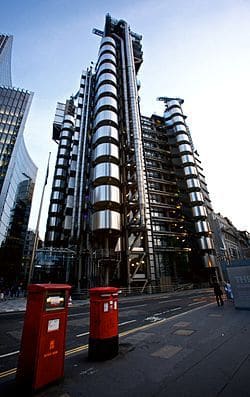
After the success of the Pompidou, Rogers revisited his distinctive inside-out structural style – known as ‘Bowellism‘ – for the Lloyd’s Building in London which was completed in 1986. The building became the youngest ever grade 1 listed building in 2011 with English Heritage saying it is “universally recognised as one of the key buildings of the modern epoch.”
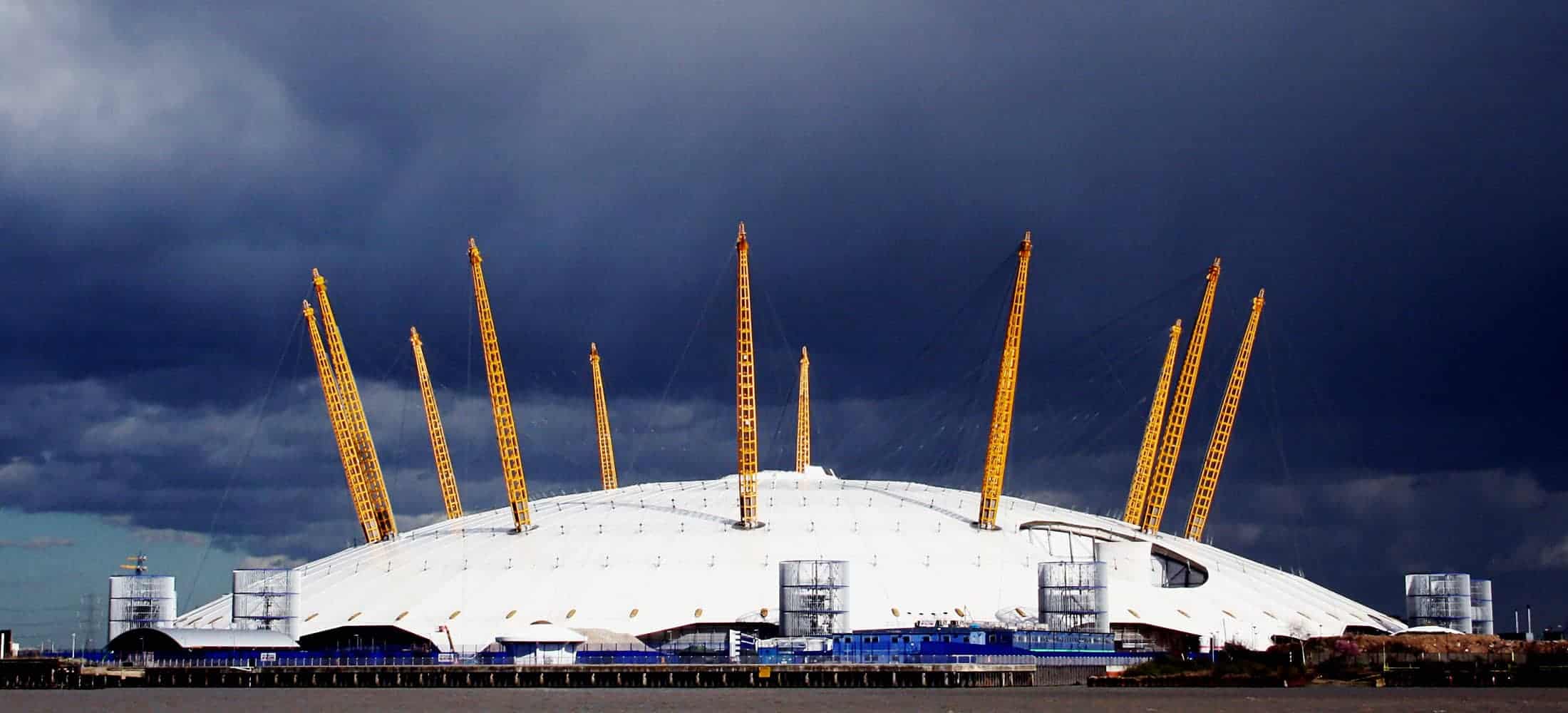
Rogers went on to design the Millennium Dome, Terminal 5 at Heathrow, 88 Wood Street, the Welsh National Assembly building as well as many other projects. He was knighted in 1981, awarded the RIBA Royal Gold Medal in 1985 and in 2007 was made Laureate of the Pritzker Architecture Prize – architecture’s highest honour. Having recently turned eighty, Rogers shows little to no sign of slowing down. His practice, Rogers Harbour Stirk + Partners recently designed London’s new ‘Cheesegrater’ building and Tower 3 of the new World Trade Center in New York.
So it’s pretty clear that Richard Rogers has had a superlative career by anyone’s standards but what really resonates with us at Blue Badge Style is his commitment to social issues. He argues for the value of public space, on sustainability and brownfield regeneration. He’s also a big believer in equal pay and in retrofitting buildings rather than building new.
Throughout the last twenty years he’s been very involved as an activist. In 1995, he became the first architect to deliver the BBC’s annual Reith Lectures in a series of five talks, titled Sustainable City. From 2001 to 2008 he was chief advisor on architecture and urbanism to Mayor of London Ken Livingstone and had a major part in composing two government reports – Towards an Urban Renaissance and its sequel, Towards a Strong Urban Renaissance. He now sits as a Labour peer in the House of Lords.
His core value is that “architecture is socially driven” and he is dedicated to opening up spaces to everyone and to the environment. This is an interesting approach and a ethos that should be admired. But, just like anybody else, he is a person with a certain amount of contradiction around him.
His critics have suggested that his words are occasionally rather more altruistic than his actions. For instance, despite espousing a commitment to the green issues he has designed various airport terminals including Heathrow Terminal 5. His response tends to be that it’s not the airports themselves which cause global warming and basically, that if Rogers Stirk Harbour and Partners don’t design them, then somebody else will.
Similarly, people have asked how the exclusive housing project, One Hyde Park, which included the world’s first £100 million apartment fits in with his values of social inclusion. Possibly it is not fair to criticise someone for what could be mere exceptions to his general approach to building. Especially since he maintains that he always at least tries to make aspects of his buildings, including One Hyde Park, publicly accessible. It is presumably difficult to achieve in the world of architecture.
Rogers’ ideal of inclusivity and his keen social conscience seem to correlate with the core ethos of Blue Badge Style – that of ‘freedom shared’. So we got in touch with him to find out about his partnership’s commitment to disabled accessibility. When we spoke to Rogers’ architectural practice, Rogers Stirk Harbour + Partners, they certainly said all the right things. We were told that they do work hard to make new buildings accessible. They haven’t really provided too many details on this other than that the architects work with with access consultant, David Bonnett, to help provide the inclusive design. So we went to him to find out more.
The job of the access consultant is to lend an insider’s view of how to overcome accessibility problems. By creating a dialogue between the architects and disabled consultation groups a solution for almost any problem can be found. It’s still a fairly recent development in the world of architecture and it’s definitely progress in terms of accessible design.
Bonnett appears to be the go to guy for access consultancy. As well as coming up when we spoke to Rogers’ practice, Bonnett has been featured in a video for the Royal Institute of British Architects, explaining the role of access consultants. He says that his process of working with the architects can create innovative solutions to accessibility issues in any building. Tellingly, Bonnett appears to view part of his role as a negotiation with the architects to make sure that the accessible ideas are implemented. However, increasingly there is a movement towards empowered consultation where the architects agree not just to consult but to implement the ideas expressed in the consultation groups.
He thinks that the attitude towards accessibility in design is changing to the extent that people aren’t over-proclaiming things anymore and that “instead of seeing it as a negative obstacle it should be seen as a god sent opportunity”. After all, as somebody else mentions in the video “architects like solving problems” –they should relish the opportunity to work with access consultants to provide accessible design.
Partly as a celebration of his 80th birthday, but also just because he’s one of the most highly regarded architects of his generation, The Royal Academy is currently putting on an exhibition about Rogers’ life and works. The exhibition is titled ‘Inside Out’ – a nod towards the Bowellist style of many of his buildings. It will look at Rogers by “focusing on key projects and using previously unseen archival material, drawings and personal items the exhibition will explore his career, from the influence of his Italian family to his impact on how we experience cities today.” The exhibition is on until the 13th of October in Burlington Gardens.
I have always thought that Richard Rogers is an amazing architect – I do admit that before I became disabled I didn’t know about his attitude to accessibility – so now he is even more amazing. I am determined to get to the Royal Academy. His buildings are inspiring always have a wonderful feeling of space.
WE agree and we’re also trying to get to his exhibition at the Royal Academy