
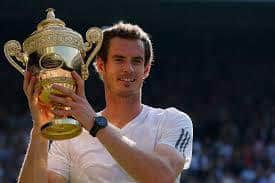
It’s all over. The entire country’s annual, two week long obsession with tennis came to a glorious end on Sunday and our 77 year wait for a British Wimbledon Men’s Champion finally finished with it. What a crazy day it must have been for Andy Murray (by all accounts, soon to be Sir Andy Murray) becoming such a historic figure for British tennis. He was absolutely brilliant out there on Centre Court. He really did himself, the country and, most importantly, his Mum proud (even if he did briefly forget about her). What a job!!
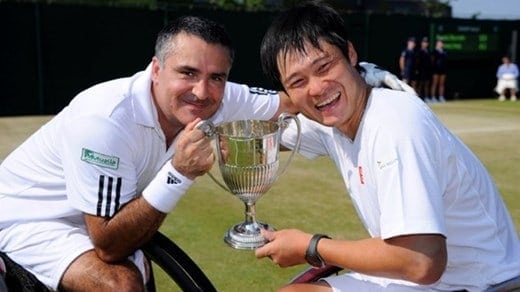
But Andy wasn’t the only Brit to be competing for a Wimbledon title on Sunday. While he was working his way to victory on Centre Court, Jordanne Whiley was competing in the Women’s Wheelchair Doubles out on Court 12 (Yes, Court Twelve – we will be coming back to that shortly.) Unfortunately, she and her doubles partner, Yui Kamiji, we’re beaten in straight sets by top seeds and defending champions Jiske Griffioen and Aniek Van Koot. It was a good effort as they were a wild-card entry and they only narrowly lost the second set on a tie-break which they had been leading. They made the winners really have to fight for it.
In the Men’s Wheelchair Doubles Stephane Houdet and Shingo Kunieda, the world number one and two, also won in straight sets. They beat Frederic Cattaneo of France and Ronald Vink in another match that was more close than the final score suggested. Britain’s number one, Gordon Reid, was also involved, but sadly on the losing team, in the third place play-off. There was better news for Britain in the third place play-off of the Women’s Tournament which Lucy Shuker and Marjolein Buis from Holland won.
So Andy Murray was far from alone in being a British tennis player in action at Wimbledon on Sunday, but you had to really go out of your way to find out about the others. Wheelchair tennis clearly is not very high on the list of priorities at Wimbledon.. They only host two doubles tournaments with four pairs participating in each competition. What’s more, as mentioned earlier, the wheelchair tennis gets stuck way out on Court Number 12 and 14 even though there are courts with more seats available. Even the Boy’s and Girl’s Junior tournaments were put above the wheelchair tennis on the much higher capacity courts like Court 1 and 3. Wheelchair tennis less popular than the juniors? You can not be serious!
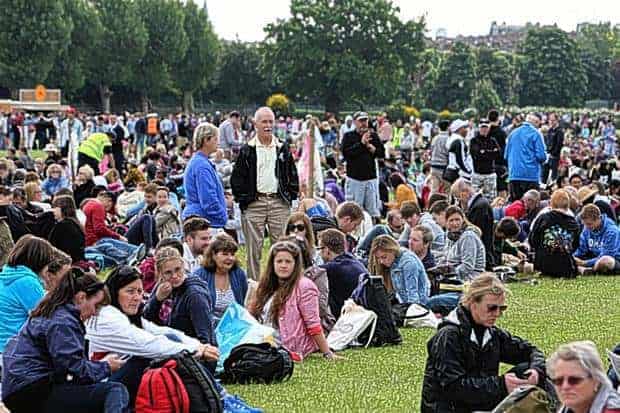
On Sunday, because of the huge number of people who bought Ground Passes (which were the only way to get into the outside courts where the wheelchair tennis was happening) headed for Henman Hill to watch the Murray match, we were left with a strange situation where the wheelchair tennis was unable to even fill these smaller courts. People who got into Wimbledon didn’t want to go see wheelchair tennis and those who did want to go couldn’t get in.
It’s also quite difficult to ask less able people to stand in, what was reported to us as being, a nine hour queue to get a Ground Pass. We should mention that there are facilities for mobility-impaired visitors to wait nearer the Grounds. But wherever you do it, waiting around for nine hours, in order to get a spot that nobody else is using, is a waste of time. Better to just watch it on TV at home although the TV coverage also left a little to be desired. The wheelchair tennis was very much a ‘red button’ service this year. Not a single point of wheelchair tennis was shown live on BBC 1 or 2. Channel 4 devoted two weeks to the Paralympics last year and now we can’t even get the two hours it takes to play a tennis match – some of which, it just so happens, began two hours before the Men’s Singles Final.
Wimbledon is clearly lagging behind the other tennis Grand Slams in terms of supporting wheelchair tennis. The French, Australian and US Open all have wheelchair singles and, having started in the 2000s, as of 2009 these tournaments have been considered the apex of the sport. Wimbledon’s entire wheelchair event, by contrast, featured eight doubles matches.
In fairness to Wimbledon, part of the problem is the grass. It’s quite a bit harder to push a wheelchair on the Wimbledon surfaces than on a clay or hard court because you can’t get the same push and glide effect. We saw that this is a commonly held view last year when, although the Olympics took place at Wimbledon, the Paralympians competed on hard courts in the Olympic Park.
However, although grass may be a bit harder to play on than hard courts it’s still entirely possible to do so. “Wimbledon is the only one of more than 170 wheelchair tennis tournaments to be played on grass,” Mark Bullock, wheelchair tennis manager at the International Tennis Federation, told The Independent last summer. The players are serious athletes – they can push themselves around a grass court.
The All England Club also claims it does not have the courts for an extra tournament. But this seems like a lazy excuse since they were only using a handful of the courts by the end of the second week. Why not just keep using the courts they have? Or extend the tournament by a couple of days if they really don’t have court space during the two weeks. If they wanted to, they could just ditch something like the Senior Invitation Doubles – surely the wheelchair competition would have far superior athletes. The ex-players of the Senior game are ex-players for a reason.

Then there’s the issue of the prize money that the winners of what little wheelchair tennis they do have receive. The winners of the wheelchair doubles were awarded only £8,500 in prize money, to share between them. Compare this to the £1.6 million that Andy Murray and Marion Bartoli each pocketed for their wins. OK, they were the main event and probably helped bring in more money for the tournament by boosting viewing figures, but does that justify them winning 188 times as much? Or, in terms of individual winnings, 376 times as much. Imagine if a Paralympic medal was a 188th the size of an Olympic medal.
For the record, the able bodied doubles winners received £300,000 between them – £291,5000 more than their wheelchair counterparts. But probably the biggest discrepancy is the case of all those who got knocked out in the first round of the singles. Barring some notable exceptions, such as Rafael Nadal this year, first round losers are not doing much to help the tournament, yet they got £23,000 in prize money. That’s nearly three times as much and they didn’t even win a match! Wimbledon finally sorted out the issue of equality between men and women a few years ago – maybe it’s time to look into at least giving the wheelchair champions as much as able bodied first round losers.
It’s hard to believe that less than a year ago everyone was talking about equality between able bodied and less able athletes. Sportsmen, politicians and the public in general were amazed by the ability of disabled athletes. The words on everyone’s lips were ‘Paralympic Legacy’ – the idea that the Paralympics had changed not only how we view disabled sport but attitudes towards disability in general.
The Paralympic legacy was supposed to have promoted and generated a real interest in disabled sport. It was starting to seem conceivable that wheelchair athletes would one day be seen on a similar level to their able counterparts. This year’s Wimbledon, with it’s lack of wheelchair tennis, limited coverage and shockingly imbalanced prize money, seems like a big step backwards on this front.