
This weekend, one year on from the London 2012 Olympics, the stars of both the Olympics and the Paralympics are returning to the Olympic Stadium for the Anniversary Games – a three day athletics event. After two days of Diamond League Athletics – ‘headlined’ by Mo Farah, (hopefully) Jessica Ennis-Hill and Usain Bolt – the final day of the event is going to be devoted to the Paralympic stars of last summer. Jonnie Peacock, Richard Whitehead, Mickey Bushell and others will appear at a one-off IPC International Challenge.
The national desire to recapture the excitement of last summer meant that tickets for the Anniversary Games sold out within twenty four hours of being released. Fortunately, the rest of us can watch it all on TV. As was the case last year, the BBC is covering the athletics on Friday and Saturday with Channel 4 airing Sunday’s disabled athletics. It’s a testament to the popularity of Channel 4’s Paralympic coverage (and of the Paralympics in general) as well as their genuine commitment to inclusive programming that they have devoted a lot of time and effort to marketing “The return of the superhumans”.
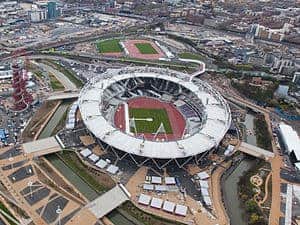
In honour of the Anniversary Games, although it’s still not quite one year since the Paralympics, we decided to start our series of Paralympics retrospectives with something about the last time the Olympic Stadium really and truly came to life. In our first look back at last summer’s Games our editor, Max, remembers his trip to the Olympic Park for a night of athletics that was later dubbed Thrilling Thursday:
After the event they called it “the night that changed Paralympic sport forever” but going into Thrilling Thursday we had no idea quite how special the night was going to be. In all honesty, I wasn’t a particularly avid follower of disabled sport. I’d been swept up in the euphoria of the Olympics which had had me glued to my TV screens for two weeks and the Paralympics had been doing something similar. But I was no expert on disabled sport by any stretch of the imagination. I hadn’t started working for Blue Badge Style at the time so I was attending the Paralympics with no work related angle in mind but purely as a fan of sports in general.
Don’t get me wrong, I knew that I had tickets for a pretty good evening of athletics. I realised that in the shape of the T44 100m final I would be going to see the blue riband event of the entire games. I knew that David ‘the Weirwolf’ Weir, who had become one of the most well known men in the country – somebody people were as likely to have heard of as Mo Farah or Jessica Ennis (and more likely than Greg Rutherford) – was racing in the 800m. I was also aware that Oscar Pistorius, the most famous Paralympic athlete of all time, would be there. Back then he was ‘The Blade Runner’, the fastest man on no legs and a household name for all the right reasons (it’s been a long year and the less said on the subject of Pistorius the better). But even knowing all that, I had no idea that events would come together to make ‘Thrilling Thursday’ the Paralympic equivalent to Super Saturday.

I arrived at the Olympic Park early in order to take look around at the all the sights. I wanted to see, in person, all the buildings that had become so familiar to everyone over the last few weeks. Wandering around, it struck me that the events of the Paralympics had come to mean just as much as those in the Olympics. For instance, when I saw the Velodrome I was reminded of the successes of the Chris Hoys and the Victoria Pendletons but Sarah Storey had become just as synonymous with that track during the Paralympics. Then there was the Aquatic Centre, where Ellie Simmonds sprang to mind even before Michael Phelps or Clare Balding’s interview with Bert Le Clos (the sort of moment that made London 2012 what it was – massive and spectacular but somehow intimate and personal). Certainly the British Paralympic swimmers had outshone their Olympic counterparts.
There just wasn’t a sense that the Paralympics were in anyway less worthy than the Olympics anymore. I think a lot of people had bought tickets for the Paralympics largely because they couldn’t get tickets for the Olympics but then when they saw the Paralympics on TV they realised that they were getting something at least on par with what they’d missed out on. The Paralympics were seen as equal and importantly there didn’t seem to be anything patronising about that.
The Olympic Stadium was about to join the other arenas that evening in becoming somewhere associated equally with both Games. There had been some pretty great evenings of Para-athletics in there already but there hadn’t been anything to rival Super Saturday or the last evening of the Olympics athletics – where Mo Farah won his second gold and the electrically entertaining Jamaicans won the 4x100m relay. Not yet anyway.
Entering the stadium, there was an amazing buzz around the place. There was an atmosphere of hope, bordering on expectation, that we were going to see something special. It didn’t take long for that hope to be fulfilled. The first big win of the evening for Team GB was Hannah Cockroft in the 200 metres. She totally blew away the rest of the field, setting a new Paralympic record. It was incredible how she dominated the race. It wasn’t even close.
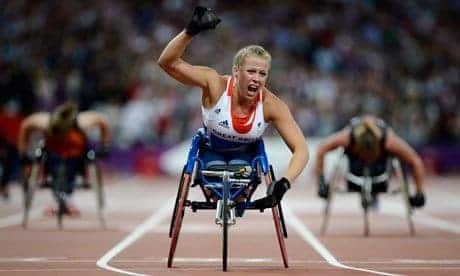
The stadium was rocking for the first time of the evening as she took her lap of honour. The lights in the seats flashed on and off in red, white and blue as Heroes blasted out around the stadium. Her win had definitely got the whole crowd thinking that there were more medals to come. But nobody was going to rest on their laurels – every British athlete was cheered on with a relentless intensity throughout the evening.
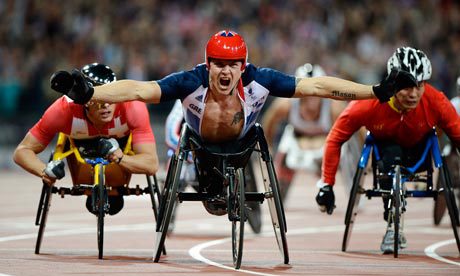
The Weirwolf was the next main event. He was introduced with the song ‘Werewolves of London’ by Warren Zevon blaring in the background. David Weir had already picked up gold in the 1,500m and 5,000m earlier in the week and he was one of the key figures of the Games. As a Londoner (and, as the man behind me kept shouting in my ear, a big Arsenal fan) there was a real connection between him and the crowd. This was the home advantage that we in the crowd liked to think played a part in dragging him to finish line of the 800m.
As Weir and his rivals tore around the track the noise went up and up and up. It was going to be a lot closer than Cockroft’s race had been. As he came into the home straight he was absolutely neck and neck with China’s Zhang Lixin and it wasn’t clear if he was going to win it. But as he approached the finish line he powered through. He’d timed his race to perfection, leaving just enough energy to speed through to his third gold medal of London 2012. It was an astonishing achievement and it felt special to be there to witness it.
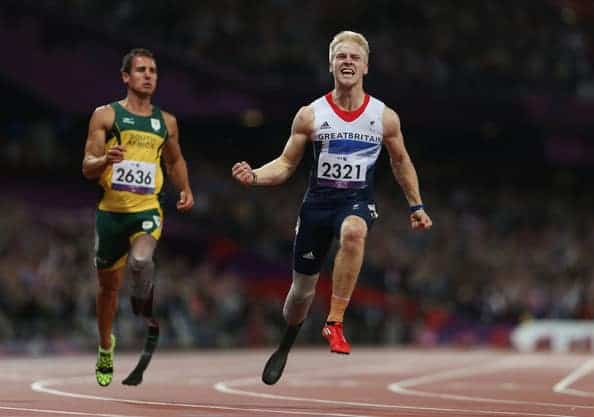
But as we all know, the evening was far from over. It’s strange to think of it as such, but the first two British golds and Weir’s record breaking win, had just been the warm up for the main event. Minutes after the Weirwolf left the track it was time for what was being called “the biggest race in Paralympic history” – the T44 100m final. It was billed as a battle between Britain’s Jonnie Peacock – the world record holder – and the reigning Olympic champion, Oscar Pistorius. It was a huge event but, at this stage, after Cockroft and Weir’s wins and with the crowd behind him, was there anyway Peacock wouldn’t win?
The runners were announced and the mere mention of Peacock’s name sent the whole stadium wild. The crowd had been whipped into a frenzy by the earlier successes and the nerves and excitement mixing around the stadium were palpable. Even as the athletes were trying to get into the blocks, ready to begin, a chant of “Peacock, Peacock” rang around the arena. There was no way anybody was going to hear the gun go off so Jonnie stood back up and gestured to the crowd to be quiet, raising his finger to his lips. That was all it took; 80,000 people in one place and you could have heard a pin drop.
After a false start, which did nothing to help with the tension in the arena, they were away. It seemed to be over before it had begun. Peacock started well, getting out of the blocks in front of everybody and from then you could just tell what was about to happen. Nobody was going to catch him. As he passed the line, in first place, the crowd exploded.
What a noise! I’ve been to football matches, basketball games and music festivals. When I was younger I went to see stock car racing which was so loud that it gave me an earache. But nothing I’ve ever heard compared to that noise. It might not have been as loud as that painful car racing experience but level of jubilation it contained couldn’t be measured. In that moment, everybody present knew that they had seen something special. We’d seen people doing things at the very peak of what is possible and nobody in the stadium that night could have thought of them as ‘less able’.
We talk a lot about the Paralympic legacy at Blue Badge Style, about whether there’s been a shift in the public perception of disability sports and disability in general since London 2012. Personally, I feel that there was a kind of paradigm shift during the Paralympics, at least in how disability is seen by the majority of people. I know that many people argue that cuts to disability benefits and the portrayal of the less able as ‘benefit scroungers’ over the last year have made the Paralympics feel like one step forward followed by two steps back. There’s two sides to every story and this is definitely something that we’ll be coming back to look at again in our Paralympic series.
I obviously can’t say for sure how much has really changed in the long term but if you’re looking for an example of how the Paralympics altered the way we see disability you need look no further than that thrilling Thursday night at the Olympic Stadium. There was real sense that these guys were doing amazing things and I think that as a result people started thinking about what disabled people can do rather than what they can’t do. There we were: 80,000 spectators in a sold out stadium, along with another 6.3 million people watching at home, all roaring the athletes on. It was a pretty incredible experience to be part of and a brilliant way to cap off an extraordinary summer.
I’m looking forward to watching the Anniversary Games this weekend at home on my TV. It’s good to see the level of enthusiasm for athletics is obviously still going strong for both able and less able forms of the sport. Sunday should be a great day but I’m afraid I have to promise you one thing: it won’t top Thrilling Thursday.
We’ll be bringing more on the games and their legacy in a few weeks for the anniversary of the Paralympics.
I thought your article was so good. I am a bilateral below the knee amputee, I also have no fingers – all from streptococcal A with septic shock. All this happened just over two years ago. My visit to the Olympic Stadium that Thursday was my first visit to London – an adventure for me. We live in Hove and drove up to London – I wasn’t quite ready for public transport! I will never forget that evening – the atmosphere was amazing. I was with my husband and our younger daughter – her treat to us – I forgot I was on my prosthetics and stood and screamed Peacock Peacock. My husband is not someone to scream and shout, was up on his feet with everyone else. The whole day was inspirational to me – sadly I will not be running in the Brazil Olympics – I am 65 this year – but I can dream!
Thank you for your comments. It’s always good to know we’re hitting the right notes!!