
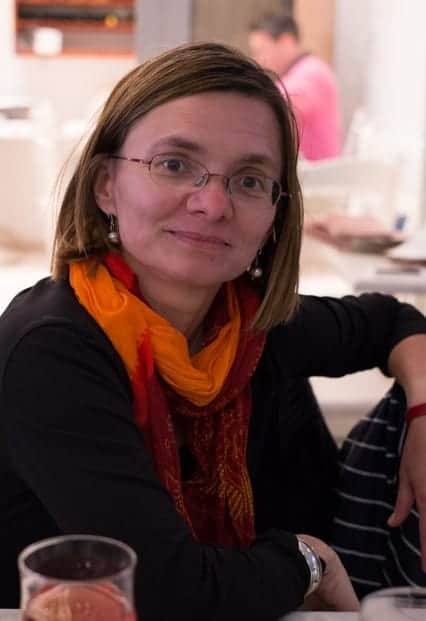
As part of Deaf Awareness Week Andra Sonea has written an article for Blue Badge Style about what it’s like for someone with a hearing impairment to work as a consultant in the city. She talks about how losing her hearing has affected her life and work and about her outlook on impairment. It’s a great piece; as moving as it is insightful. BBS wants to thank her for her input.
In January 2001, I lost my hearing suddenly after what I thought was just a bad cold. Despite extensive investigations, the cause of this sudden hearing loss is still not clear. It could have been stress, a virus which affects the internal ear or even the very strong and unusual antibiotics I was prescribed.
I lost my hearing for high frequency sounds almost completely while preserving normal hearing for usual human speech frequencies. This is an unusual hearing loss for a young person and at the time, the hearing aids I tried hindered my hearing, rather than helping it, so I didn’t wear any.
I think losing my hearing has affected me in ways I was not aware of at the beginning. At the time, I had just moved to Germany and I was not yet familiar with the language, the environment and I had a very small circle of friends.
Looking back, I think it became tougher to mix easily with groups of new people because I was not sure if I could take part in the conversation. I didn’t know if this was because of my hearing or the adaptation to a new culture.
It helped a lot that I’ve learned many languages before and acquired a sense for language structures. This meant I could compensate (partially) for what I was missing. I guess I put a brave face and I tried to make the best of what I still had. Since then I have done an MBA and worked in many countries. I guess I’ve missed a lot but I’m not sure what!
I started wearing hearing aids two years ago. The difference is almost imperceptible but it helps a lot with the clarity of speech, especially for certain English accents or German language. Very often the hearing aids compensate almost completely for the hearing loss so there is no need to tell others about it. That means I don’t think people see me differently because of my hearing loss. In fact, most people don’t even know I have a hearing impairment.
Hearing loss is what I call an invisible impairment. People can’t see you have a hearing impairment when they meet you and that can be a blessing and a curse. Sometimes, in the absence of information on why you don’t understand what everyone else understands, people can become impatient and easily categorise you as a bit dumb or they think you just don’t understand the language well. That’s part of why I think it’s important to be open about things, difficult though that may be.
As a consultant, it is nigh on impossible to have any control over your working environment. You usually travel to the client and you never know where you’ll have to work or how noisy the environment will be. In the world of hot desking, when all those very hot desks were taken I worked from various Starbucks coffee shops at client sites. I have seen more than my fair share of Rihanna videos on TV sets in the background and needless to say, that doesn’t help my conversations.
I do prefer to have face to face discussions, in small groups whenever possible. However, nowadays, because of my work, it’s very difficult to avoid conference calls, with tens of participants who you don’t know and sometimes have never even met. Quite often, I inform people early on that I have a hearing loss, especially in conference calls with multiple participants from many countries. In a large conference call I also ask people to identify themselves before speaking so I keep track of what’s going on.
I use Oticon Agil hearing aids and sometimes I use a streamer which links the hearing aids with my iPhone. I also have a tiny microphone that I can use in larger conference rooms with poor acoustics. I put the microphone on the table and the sound is delivered to my hearing aids directly.
For half a year I had a regular call at 8:30am when I was driving so I had to time myself so I could be in a quiet parking place with a good phone signal. To match the timing during morning traffic with finding a quiet place where there was good phone signal was quite stressful. For somebody else this would have just been a case of taking a call while driving. For me it was an entire logistical exercise.
I also have difficulty occasionally at corporate events which take place at a wide variety of locations – from churches, to ball halls to concert venues. More often than not, even if I try to participate I end up very frustrated from not understanding. While all companies say that they support all disabilities, in reality there is very little awareness of what it means to accommodate them.
Some things can be really trying to have to contend with. For instance, because of difficulties hearing, I rarely go to the movies anymore and that is something I miss a lot. Cinemas have very loud sound but for me the problem is not the volume but the clarity of the sound. I am not always comfortable telling my friends that I need a “translation”, from time to time, in order to keep pace with the movie because I don’t want to spoil their movie experience. The only person who kind of got it and even volunteers information during a movie without being too bothered is my teenage son.
I also miss almost all public announcements even now when I wear hearing aids. Only after the platform or the train is totally deserted do I realise that something is wrong!
I think we all develop our own very specific techniques for dealing with an impairment. Hearing loss is experienced differently from person to person, given the type and degree of loss, the environment where you spend the most part of your day, the language you speak and the accents of people around you. For me the most important thing is to acquire an easiness around informing people about your impairment and to spell out how you want them to assist you.
Personally, I took inspiration for this from an article by Dan Palotta published in Harvard Business Review. It might seem a long shot to you because he’s a successful social entrepreneur and is not impaired at all. But he is also gay and in the article he talks about authenticity and standing for who you are.
Palotta says that an authentic gay person does not come out only once but needs to come out constantly – when he/she buys flowers for his/her partner, or talks about kids with a new acquaintance, etc. He says “your ability to stand up for yourself is a muscle; the more you exercise it, the stronger you get.” I tend to think of hearing loss a bit like this. In a similar way to a young gay person thinking about coming out, you think “Why should I make a big deal out of my hearing loss? It does not really matter”. But hearing loss is an invisible impairment and very often if you don’t tell others what is happening and what you expect of them, they cannot help you.
I took inspiration from Palotta and I think that this is what helps me the most in dealing with the shortcomings of my hearing impairment. The reality is that you can only go up to a certain point in overcoming an impairment by yourself. To maximise your potential you need to confide in and trust the people around you. A more complete integration with the more able world comes from the kindness of others and their willingness to make that extra step that you cannot make despite your best efforts – whether that’s making the effort to talk with you during a movie, to take a meeting minute, to meet you face to face or to make that call just to say hi.
Dear Andra
What a beautiful article. I had no idea.
John