
We’ve started the Blue Badge Style Sports Blog to help advise less able people on how to get into sport. Each week we feature a different Paralympic athlete telling us about their own sport.
This week we’re featuring an interview with Great Britain’s Sitting Volleyball Captain, Rob Richardson. Rob has been involved with the GB team since, pretty much, day one and has shared all the ups and downs that the sport has been through during that time. We met up with him a short while ago to talk about David Beckham, Top Gun and how to inspire a generation to join in and start playing Sitting Volleyball:
Rob Richardson was born with a disability but, when he was growing up, he says “I just always wanted to play sport with my friends and fit in.” When he was fourteen, his leg worsened and he started to struggle to take part in activities like playing football and cricket with his friends. “I had the amputation” he says, but he didn’t let that stop him – “I just went back to running around and doing what my friends were doing.”
In 2005, when London won the right to host the Paralympic Games Rob decided to take the step up to playing for Great Britain. “After being egged on by some of my friends, I sent an email to the Paralympic Association, basically just asking for a sport,” he remembers, “Then I went to some talent ID days and tried out a few sports.”
His previous links to volleyball had been, in his own words, slightly tenuous: “I played a bit of beach volleyball in Australia when I was a bit younger, mainly as a way to meet girls. But there it was – it was useful that I had a small background in the sport.” From that small connection to the sport, Rob’s gone on to become his country’s longest serving player and captain.
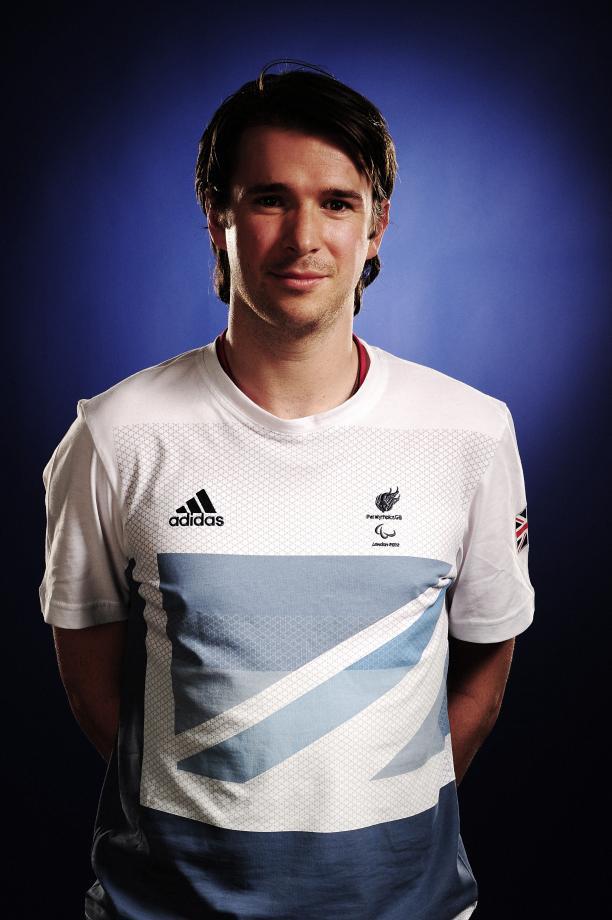
Rob comes from a family with extraordinary sporting ties. His dad was a professional cricketer for Warwickshire and was Chairman of Coventry football club, both of his uncles played Cricket for England and his sister rode equestrianism and dressage in the British team. “I think I was kind of destined to do something like this because we’re a massively sporting family. None of my family ever featured at the Olympics though, so I kind of ticked that angle off now.” Rob says, “It makes things really easy for me because I’ve missed many family engagements over the last few years but they understand sport and they’ve been through the same thing. So it does make life a bit easier.”
Rob’s seen GB Sitting Volleyball progress an enormous amount during that time. “We started up from scratch in 2005 with about ten of us in a shack, in West London, trying out this sport for the first time,” Rob recalls, “I’m the only one still playing from that shack. To go, from there, to creating a world class team in such a short space of time is incredible. The challenge for us now is that, for Rio, we won’t have the host nation spot to rely on, so we have to go and qualify. Which will be hard but we’re up for the challenge.”
It’s a challenge that has been made all the harder with recent news that UK Sport has withdrawn funding for Sitting Volleyball. When asked about this Rob seems disappointed, but understanding of the decision. “It’s a bit of a sickener to be honest,” he says, “I think that the reasoning is that, if they give a million more pounds to rowing, they might squeeze out one more medal in 2016 and then, they maybe think, if they give a million to volleyball, we probably won’t. To be honest, I agree with them but to get to a position where we are going to win medals, we’re going to have to have some funding along the way.”
For now, the GB Sitting Volleyball team is operating a sort of skeleton training schedule while they look for new means of funding. “We’re talking to corporate companies to see if we can find some sponsors in order to run a programme,” Rob says, “even if it’s just that someone sponsors the kit, someone sponsors our medical side of things. We’re going to have to raise some money somehow.”
He remains hopeful that they might make the people at UK Sport change their minds. “The idea is to go to the European Championships this September in Poland,” he tells me, “Our hope is that we can go there and if we finish in the top five or something, then UK Sport might look at it again and go ‘you know what? They did a really good job. Let’s give them some money’.”
At the moment, the team train when they can, which is not ideal considering some of their opponents at the European Championships, such as the Bosnian team, will be full-time, professional athletes. “As it is, we’ll probably be able to train monthly, paid for out of our own pockets. It’s better than nothing though.” Rob says, “At GB level, it is hard work. We do a lot of gym work on core stability, free weights on our body strength and stuff like that. The on-court sessions can be quite demanding – just getting beasted and sliding around the court, sweating loads.”
For beginners things are not quite so hardcore. There’s a great system in place offering a choice depending on how seriously you want to take the game. “If you were someone getting into the sport, then there are different clubs all around the country,” he says, “Some of them are really geared at a recreational level, just for people who want to try a new sport and get fit and then others are a bit more competitive. You find where you need to be with it really.”
“One thing I would say is that, having done hundreds of coaching days for schools and things like that, you realise that when people are playing for the first time, they’re a bit aware that it’s a ‘disability sport’, but it soon becomes apparent that everyone’s equal. When everyone’s sitting on the floor, sliding around, just playing volleyball, you see that it’s just a different sport. I think that as soon as you take the stigma of it being a ‘disability sport’ away, it’s a really important step. Kids are great with it, they’re just like ‘what’s disabled about this? Sliding around on your bum – it’s just good fun.’”
Another thing Rob sees as helping to break down these barriers, regarding disability, is being able to laugh about it. “As a group of amputees in a team, we have quite a dark humour about disability and we just get on with it,” he smiles, “we don’t get down hearted or anything like that. That’s kind of my background to it all – it’s not about feeling sorry for yourself. When you have a taboo subject, like disability, once you can start to make fun of it in public and on TV and stuff, then you know that you’re starting to break down some boundaries”
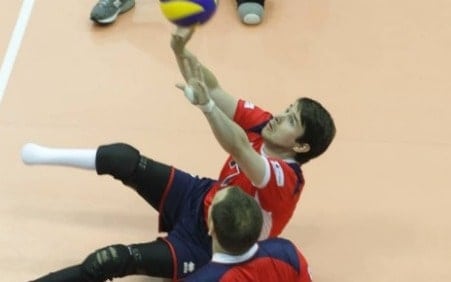
I asked him to quickly summarise how to play Sitting Volleyball and he emphasised a level of simplicity to it, at a more basic level, which means anyone can join in: “Sitting Volleyball is really easy,” he told me “It’s much like Indoor Volleyball. It’s six versus six people and you get 3 touches with the ball on each side of the net to try and score a point. It’s really easy to pick up the rules and there is a big club structure in the UK.”
It’s a really accessible game which is initially easy to pick up and liberating to experience. “Even with me, as an amputee, taking the prosthesis off, or being liberated from your chair is quite a nice feeling for people,” Rob says, “It’s nice to be out the chair and you don’t need expensive equipment to play. You need a net and a ball and that’s it. So it is really easy from that side of things.”
It’s also really easy to find a way to get involved in the sport. If you want to find out about Sitting Volleyball “a really good website is the Volleyball England website. They’re the national governing body and on their website they’ve got a find a club tool. It’s got rules and all the information you need in order to get started. There’s also the Paralympics GB website called Parasport which has got an overview and a video of volleyball and things like that. If you want to find out more it’s quite easy to do so.”
As it becomes more advanced, Sitting Volleyball becomes a hugely tactical sport, which is something that attracts many people to the game. “It’s not a power sport, like rowing or something like that, where the strongest or most physical normally wins,” Rob says, “Volleyball by its nature is very technical and tactical. We have to outthink the opponent. It’s about finding gaps in a small space, so you have to outsmart the guy on the other side of the net from you, which I quite like about it.”
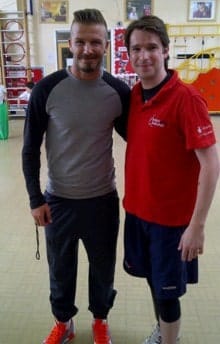
In the run up to the Games Rob met David Beckham, who had been a long time sporting hero of his. “I was lucky enough to meet him and we went to a school together in north-west London to do bit of coaching,” Rob says, “we sat down together on a court and played a bit of Volleyball together which was wicked. He was quite handy. If he ever, God forbid, loses a leg or something, we’ll be sure to give him a call.” he jokes.
Rob describes the time he spent with Beckham as a real eye opener into handling the pressures that can come with being an elite sportsperson. “In the Games, if we had a day off and went for a little wander outside the village, we’d be mobbed for autographs and stuff like that,” he says, “we were quite aware that if you say ‘no’ to people you’re actually harming the sport you play. So we would make sure that we were happy and smiling, doing everything that we could do to keep inspiring young people who perhaps have never seen disability sport.” For David Beckham every day is like, which could become wearing, but “he was a lovely guy, he didn’t have a big entourage or anything like that. He was really approachable.”
Sitting Volleyball players may be some way off the celebrity status of David Beckham, at least in this country, but in Bosnia and Iran they are very high profile. This comes, in part, from their success Rob explains: “Everyone else is literally fighting for Bronze because they are leagues ahead. They’ve got a fully professional league in Iran. When we’ve ever played them they’ve always had a film crew following them around wherever they’ve been in the world. In Bosnia, they have a professional league too and they make a good living out of it.”
A lot of the players from these two Sitting Volleyball superpowers have been war veterans. With this (and that famous scene from Top Gun) in mind, I ask Rob if Volleyball tends to have links to the military. “That’s why I got into the sport of course – that beach volleyball scene in Top Gun,” he jokes. Apparently I am far from the first person to bring up Top Gun around him. He seems amused by how much it comes up but agrees “it’s the only film I can think of that’s got volleyball in it”.
Moving back onto more serious matters he adds “they play Sitting Volleyball a lot in Headley Court, which is the rehab centre for injured servicemen. You don’t need a prosthesis or anything so it’s quite a good rehab sport. At that stage it’s quite low impact because you’re not crashing into each other like you do in Wheelchair Rugby or Basketball. They get into it early, it’s just about trying to keep them playing.”
Quite a number of the GB Paralympic squad have taken this route into Sitting Volleyball. “We have a lot of guys from Iraq and Afghanistan,” Rob says and these ex-army players have done a lot to improve the squad. One of them, Netra Rana, was voted the second best Libero – a defensive specialist position requiring quick reactions and bravery – at the London Games. “If the ball’s flying at his head, he isn’t scared,” Rob says, “he’s a Gurkha!”
Other members of the squad also showed, at London 2012, that there is promise in this team. John Munro was voted the Games’ best blocker and Rob was himself voted second best server. Rob sees that huge progress is being made and it must frustrate him that UK Sport didn’t seem to recognise this. “Going back to the funding announcement,” he says, “I think we’ve shown in a really short space of time that some of the players in our squad are world class. It’s just a shame that perhaps they couldn’t see that some of the other players are coming up to that level as well.”
Rob remains determined to show UK Sport what his team can do. “We’ll just have to prove them wrong,” he says, “There’s a bit of unfinished business from the games. No one wants to go to a Games and lose a few matches. We want to do a bit more.”
His team will carry on funded or otherwise: “It’s all we can do,” he says, “Either that, or everyone packs up and goes home, and I don’t really want to do that.”
We want to thank Rob for helping out with the BBS Sports Blog and giving us a fantastic interview. Some really inspiring stuff about overcoming the odds and just having a good time too! We wish the GB Sitting Volleyball team all the best in the future.
Next week we’ve got a guest blog from the Swimmer, Ollie Hynd, who won three medals (a tidy Gold, Silver and Bronze) at the London Paralympics.