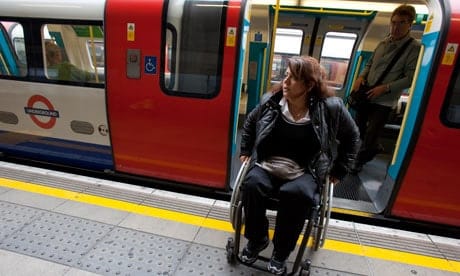
I am a lucky Londoner. I managed to get my hands on tickets for two Olympic events. As a wheelchair user, it is even more fortunate that the London 2012 Olympic and Paralympics Games are set to be the ‘most accessible yet’ according to Transport For London (TFL). However, after testing out my route from Stratford home to Hammersmith, I discovered the reality is very different.
The journey began well, the Jubilee Line from Stratford via Canary Wharf to Westminster benefiting most from the millions invested to make 66 of 270 tube stations accessible. In this bubble I was impressed and somewhat relieved at the accommodations my city was making. Sadly, the experience on my return to Hammersmith made my blood boil.
For those unaware, there have traditionally been two types of access available for wheelchair users on the London Transport. Stations such as Waterloo or the Jubilee Line offer access from both the station to the platform and the platform to the train. Others only provide one of these. This means you can get off the train or tube, but remain unable exit the station to the street. In other cases the station may have a lift, yet no ramp to help the individual off the train.
My journey should have been easy, because Hammersmith is listed as one of just 16 stations provided with ramps in preparation for the Games. I even rang the TFL helpline before my journey, who confirmed Hammersmith did have these facilities. The accessible journey planner on the TFL website stated the same.
Problems began from the moment I got off the train at Westminster to change to the District Line. No staff were immediately present to assist me at the platform connecting to Hammersmith. Confused, I eventually found a help button against the wall and reached customer services who agreed to send staff to help. Once they arrived, the cracks began to appear: “I’m sorry Sir, there are not enough staff at Hammersmith to help you once you arrive.”
After I queried how this was possible, the supervisor said: “They haven’t been trained. You need two members of staff to use the ramp and hold it steady. We can send you to Earl’s Court or pay for a taxi to get you to Hammersmith.”
Adamant that I wished to continue travelling along the supposedly accessible route, I agreed to go to Earl’s Court and then catch a bus. I could not help noticing the staff seemed unsure of the ramp, treating it like an alien species. Confirming my suspicions, the supervisor said: “We’ve only had it for two weeks, you’re the first person we’ve tested it with.” I have never felt such an honour.
On the busiest day of the Olympic Games, it is estimated 23,000 passengers with mobility difficulties will be using the network. TFL need to get the staff trained soon, otherwise they will be facing a substantial and unnecessary taxi bill. Others take matters into their own hands, the GB Sitting Volleyball captain, Claire Harvey said: “Sometimes I’ve had to get out of my chair and shuffle downstairs when there’s been no alternative. I am lucky I am able and happy to do this, others may not.” It should be shocking that Ms Harvey has to do this, but many wheelchair users will not be surprised.
It gets worse. Although the ramp and passenger assistance worked smoothly at Earls Court, I was told that despite the station having the ramps for months, they have only recently been certified for use due to an insurance issue. This agreement is a temporary measure, solely valid for the duration of the Games. After 9 September, staff will be prohibited from using the ramps until the contract is renegotiated. It is pointless for wheelchair users to use the accessible journey planner on the TFL website if it does not contain reliable information.
Scenarios such as this devalue the tremendous effort TFL are putting in to improving their services over the next few years. A myriad of measures, including plans to deliver step free access at the busiest interchange stations, such as Paddington and Tottenham Court Road by 2018, are a step in the right direction. In 2008, Sebastian Coe, chairman of the London Organising Committee of the Olympic and Paralympic Games said: “The Games should inspire change and be a real catalyst for lasting benefits.” As things stand, there is a danger that the Games will inspire this change for all the wrong reasons, by highlighting the inefficiencies rather than the possibilities.
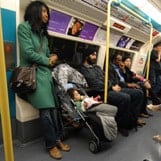
It is not only access to the London Tube network that is marred by red tape bureaucracy and inconsistencies. My experience taking the bus from Earl’s Court to Hammersmith was similarly infuriating. The driver initially refused me entry because there was a buggy on board. I pleaded with him, not only because I knew I could fit on board but because it was pouring with rain.
Eventually, I was allowed on after other passengers protested. It should not have come to this, the Big Red Book given to all drivers states wheelchair users should be given priority by asking the passenger to fold up their buggy. Campaign group, Transport For All, are fighting these problems through their manifesto, which includes a commitment to ensuring “penalties are implemented for bus companies which regularly fail to meet minimum standards in relation to access for wheelchairs; broken ramps; pulling into the curb and giving passengers enough time to sit down.” Part of the problem is that TFL’s contract with bus operators requires monthly service checks; this is not enough to ensure an adequate level of service for wheelchair users.
I arrived in Hammersmith dejected but hopeful for some answers about the insurance issue and staffing problems. I found one member of staff who solved the mystery. Hammersmith have no ramps. The station supervisor refused to speak to me about the issue, he only said: “I know nothing, there is no money, ring the helpline”. I explained I had. He responded by telling me to do so again. If the reason for the lack of ramps is budget related, we are in serious trouble, as one rail ramp costs £385. I have given TFL a chance to comment, but they are yet to respond.
As I left the station, with my Freedom Pass in hand, ironically entitling me to free travel, I heard the jovial voice of the Mayor of London, Boris Johnson, over the tannoy system telling me to get ahead of the Games. Many wheelchair users will be happy to get anywhere at all.