
With Easter fast approaching, this week we’re providing information on European city breaks in places with good disabled access. If you were thinking of booking a last minute holiday this Easter then these may be ideal places to go. We’ve found where to stay and hopefully provided as much information as possible about where to go if you are travelling with a less able person. Today we’re focusing on the beautiful medieval city of Ávila:
Ávila is a small city in central Spain. It’s renowned for its beautiful medieval architecture which has seen it named as a UNESCO World Heritage site. In the UNESCO description of Ávila it says that the city received World Heritage status because of the way it has maintained it’s architecture of medieval austerity. But at the same time as maintaining this “medieval austerity” Ávila has also made progressive changes to the city’s architecture to help mobilise the less able. In 2011 it was named as the EU’s first ever city of access for the work they have done.

Ávila is best know for its amazing medieval wall which surrounds the Old Town, for being the home of Saint Teresa of Jesus and for its delicious sweetmeats which are made by local nuns and sold in small shops throughout the city. The wall that surrounds the city dates back to the 11th century and remains one of the key features of this historic town. As far as I can gather there seems to be some confusion as to whether there are 82 or 88 towers on the wall; either way there are plenty of towers.
What really makes Ávila stand out from other, similar, medieval European cities is that it was the first-ever winner of the European Access●City Award in 2011.
The Access●City Award is an annual honour which aims to award efforts made to improve accessibility in an urban environment and to foster equal participation of people with disabilities. It is presented to one European city each year by the European Commission.
Viviane Reding, the EU’s Justice Commissioner, said that “people with disabilities have the same rights as everyone else, but accessibility is a precondition for them to enjoy those rights. The Access●City Award gives recognition to those cities which have shown the most effort to improving accessibility. This honour should inspire and motivate cities that still have more progress to make.”
Ávila won the inaugural award because it “is an ancient city with a challenging environment where accessibility has become a core issue running through all municipal policies and is applied to all spheres of society including town planning, building, communication and transport.”
Since 2002, Ávila has worked extensively to improve accessibility to public buildings and to give incentives for private initiatives to do the same. It has also developed accessible tourism facilities. It’s quite an achievement, especially for such a relatively small European city, to win this award.It makes you think it must be a excellent place for less able people to go on holiday.
We were made aware of the great access in Ávila recently by Ann from XENI Fashion who went on holiday there last year. Here’s what she told us about the access there:
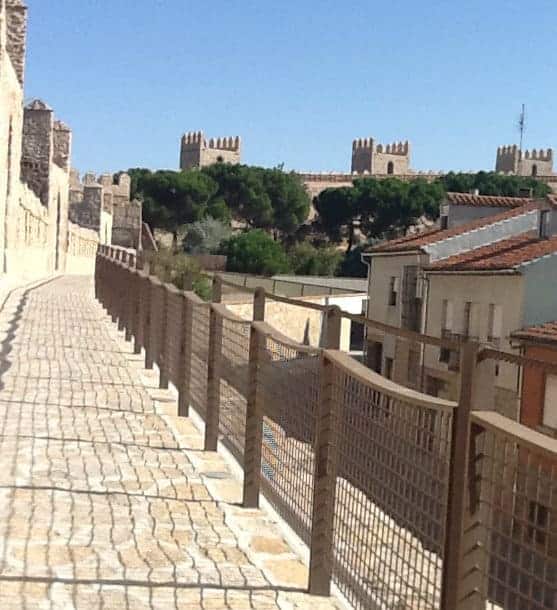
“Ávila is a beautiful hilltop town in the centre of a Spain, surrounded by some spectacular walls, that has made a section of those walls accessible to wheelchairs!”
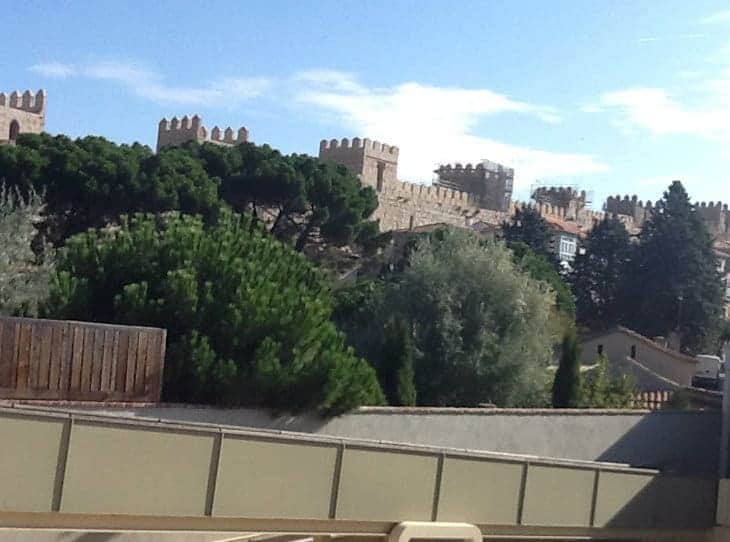
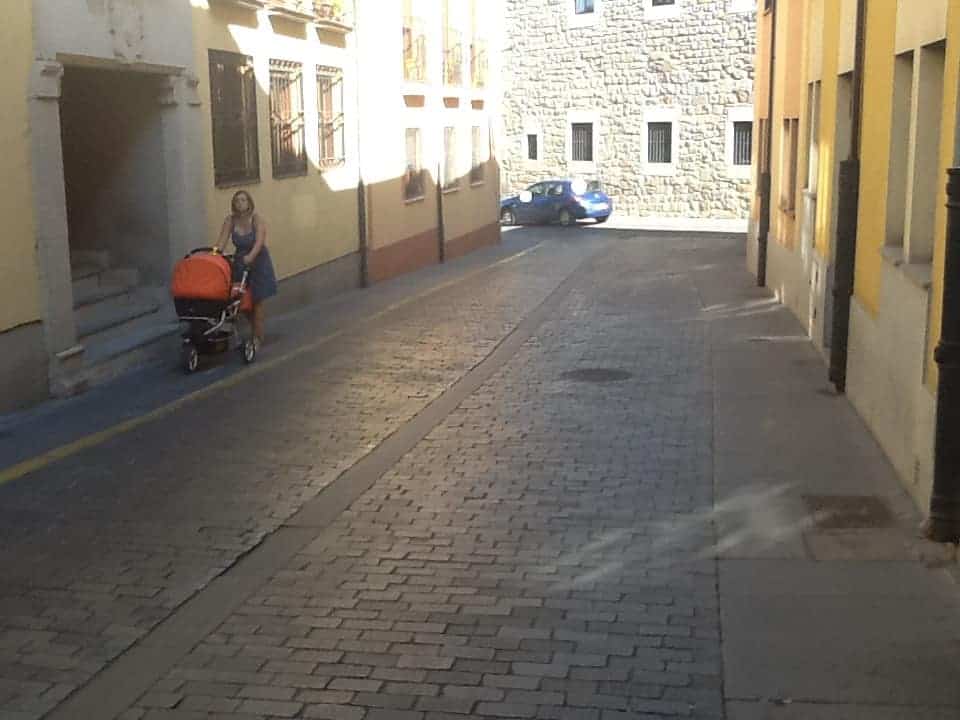
“All their pavements are flush with the surface of the road. Because of it being a very contorted old town, traffic is slow and all the roads are paved with sets, so cars make quite a noise running on this surface. This means you are always aware of where vehicles are.”
“We stayed at The Parador which did have an accessible bedroom but being a very old building compromises have had to have been made. This meant we had to go through the kitchen to get to meals in the dining room. Not the end of the world and it did have a beautiful cooling garden set right up against those stunning walls.”
“I would really like to celebrate the efforts that have been made in Ávila. It was really such an unusual place to find such care being taken on our behalf.”
We thought we’d draw people attention to the idea that Ávila might be a good place to go for a holiday this Easter (or even in the Summer if you’re well organised like that). It should be warm at that time of year – at over 1,000 above sea level Ávila is Spain’s highest city meaning it can be bitterly cold during the winter, but by spring the temperature should be better (if you go in summer it is relatively mild there compared to Southern Spain or even Madrid).
With it being a holy city we assumed that there were bound to be activities going on during Easter and that assumption proved to be accurate. The Holy Week of Ávila was even declared an event of National Tourist Interest in 2005. The week involves many activities and celebrations, including a series of processions through the city, as well as other events going on. Oddly, during this time it is traditional for the inhabitants of Ávila to play pool (which is apparently known as the ‘game of sheep’ although something may be lost in translation there) and baccarat in the city’s casino. It all sounds like an interesting experience.
The walls encircling the town were built the 12th century and are almost two miles long. But it’s not all about the walls, there are also many medieval buildings within the Old Town which are worth visiting. These include San Vicente church and the Monasteries of Santa Teresa and Santo Tomas. On top of that, Ávila Cathedral is considered to be the first Gothic cathedral in Spain and is surrounded by a number of small palaces.
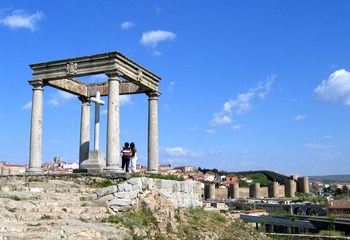
Another particularly interesting site about 1.5km outside of the city walls is the “four posts” shrine. It is said to mark the spot where, at age seven, St. Teresa’s uncle stopped her from running off to seek martyrdom in battle. Perched atop a small hill, the site also provides a splendid view of the Old Town.
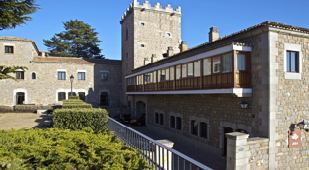
In terms of where to stay, The Parador or Hotel Raimundo de Borgona, which Ann mentioned, may be the best hotel. Part of the popular Pardores chain of hotels – which is something of an institution in Spain – it is on the site of the former “Piedras Albas” palace in Avila and backs onto the city walls. The interior has a warm and intimate feel with bright colours and interesting decorative features. It seems to be the best hotel for combining style, quality and a good location whilst also having disabled access and facilities.
El Almacen is generally the top rated restaurant in the city. They do creative takes on traditional Spanish dishes, in an old warehouse with spectacular views of the city walls. They say that the restaurant has good disabled access and facilities. Another popular spot is Alcaravea which is more central and a bit cheaper than El Almacen. It’s positioned in the Plaza de la Catedral, opposite the cathedral and apparently attracts a younger crowd. The most popular food in Ávila tends to be red meat dishes, particularly veal which is very good in that area of Spain.
Àvila seems like a top place to go for the less able. As a city that has won an award for it’s accessibility it is obviously somewhere looking out for people with disability which is something that can only be praised. But what makes it more remarkable is that Àvila manages to combine so much medieval history with such thoroughly modern accessibility. This award helped put Àvila on the map which is great because up until then it was something of an overlooked gem!